




Power of a point
This issue is not fully translated into English yet; only translated content is shown.
Read the French versionAll folders in this issue

Power of a point
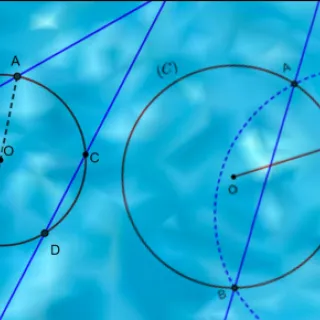
A point and a curve: that's all you need to define a geometric concept of formidable effectiveness, the power of a point. The most well-known case, although absent from today's school curricula, is the power of a point with respect to a circle, or more generally with respect to a conic. Since Antiquity, Euclid could have brought out this concept! Yet one would have to wait until the 19th century for Jakob Steiner to undertake a systematic study of these transformations. The power of a point considerably simplifies the search for geometric loci and leads to the concept of duality, thus opening up vast and new perspectives.

Making math... at any age!
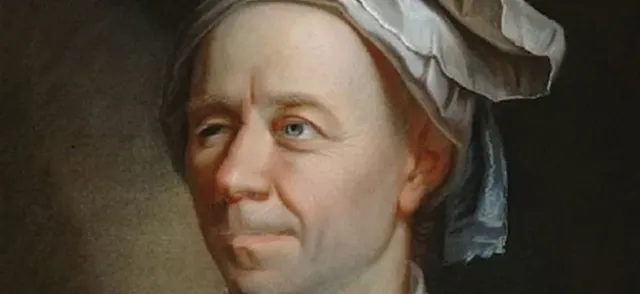
We generally like to highlight "genius" mathematicians, those who, very early on, showed undeniable predispositions for the queen of the sciences. Less is said about those, just as deserving, who continue their activity beyond a canonical or even venerable age! It must indeed be remembered: if mathematics wonderfully lends itself to the boldness of youth, it can appeal to all audiences, at all ages. Neuroscience confirms this today! This is what explains the extraordinary longevity of certain researchers, who have always followed their curiosity and never stopped trying to unravel the deepest mysteries of mathematical science.


All articles in this issue

Hervé Lehning (1948–2022)
Tireless in his work, Hervé Lehning devoted his life to sharing the mathematics he loved so deeply and making it accessible without sacrificing quality, driven above all by a desire to pass on his passion. But he was much more besides.

From coin tossing to stochastic differential equations
Tossing a coin many times naturally leads to an interest in certain types of paths on a line, in a plane, in space… The random nature of these experiments means that their study goes beyond the classical framework of ordinary differential equations.

Jobs and the economy: the importance of mathematics
In mid-September, the Institut national des sciences mathématiques et de leurs interactions (INSMI) at the CNRS published a study on the impact of mathematics on the economy and employment.
A podcast devoted to Ada Lovelace
Bababam's "True Story" podcasts tell remarkable true stories that are a pleasure to listen to and share.

A comic book introduction to Maryam Mirzakhani
Iranian mathematician Maryam Mirzakhani (1977–2017) became the first woman to win the Fields Medal in 2014.
Tangente's 35th Anniversary
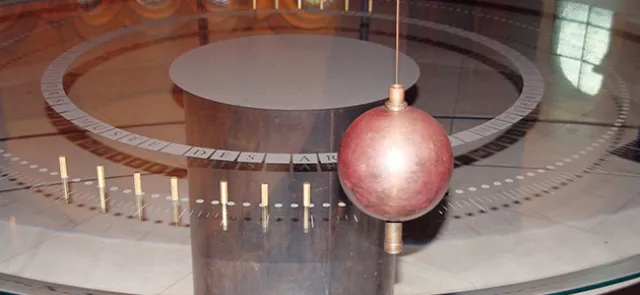
Come celebrate a unique anniversary, the 35th anniversary of the only magazine of mathematical culture in the world sold at newsstands! There will be something for every taste, every age and every level. Here is a preview of what this eventful day has in store. The full program can be found at the end of this article.

The factorization of large integers:
The most widespread cryptography system relies on the use of very large integers, whose factorization remains beyond the reach of our computers. As early as the 17th century, Mersenne and Fermat were investigating the prime factorization of very large numbers; their work inspired modern factorization algorithms.