Mathematics: 18% of French GDP!
----------------------------------
The study shows that, in 2019, 3.3 million salaried workers—13% of all jobs—were employed in roles where mathematics was the main activity; 35% of these jobs were concentrated in Île-de-France. These roles also represented 18% of France's gross domestic product (GDP), compared with 12% and 16%, respectively, in 2012.
What is driving the growing prominence of mathematics? The main cause is undoubtedly the increasing digitization of work and, as the report puts it, "the need to understand complex systems, process and interpret data, make estimates and forecasts, or apply mathematical reasoning to decision-making".
Mathematics plays a part in every field, including some unexpected ones such as agriculture, where anyone seeking to accelerate the transition to more environmentally friendly farming must, for example, formalize expert knowledge and model risks. But the fields most affected are IT, engineering, management, financial services, auditing and insurance. They account for around half of all jobs affected by mathematics. The arrival of artificial intelligence in some of these sectors has certainly contributed to this.
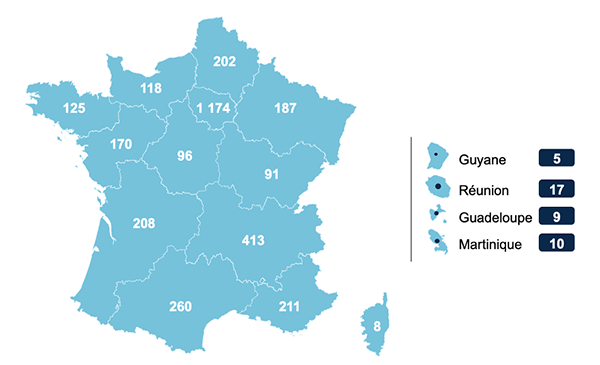
Number of salaried jobs affected by mathematics
in France in 2019 (thousands).
As the INSMI report indicates (see above), the French education system struggles to convey the importance of mathematics. Trends differ between secondary and higher education: since the 2010s, enrolment in higher-education mathematics has grown slightly—by an average of 6% a year since 2012—but, at the same time, average attainment in primary and secondary education has declined (see France's results in the TIMSS assessments at the CM1 (fourth-grade) and 4th-grade (eighth-grade) levels, where it ranks second to last among European Union countries!). The number of students taking mathematics courses in secondary education is likewise declining. And the latest reforms, particularly the baccalauréat reform, have done nothing to improve the situation. Quite the opposite (see Tangente 205, 2022)!
The Maths-Sciences collective brings together teachers' associations, notably the APMEP (Association des professeurs de mathématiques de l’enseignement public); learned societies such as the SMF (Société mathématiques de France) and the SMAI (Société de mathématiques appliquées et industrielles); and associations promoting women in scientific fields, including Femmes et Mathématiques, to name just one. It has made numerous recommendations for improving the situation. So far, they have all gone unheeded…
Mathematics "essential to innovation"
---------------------------------------------
In late March, thirty leaders of France's largest companies, together representing a quarter of GDP, signed a call to "save mathematics" and called for mathematics to play a greater role in primary, secondary and higher education curricula. They also recommended that academia combine rigorous mathematical training with businesses' need to embrace digital technology and data.
In the preface to the INSMI report, Bruno Le Maire, Minister of the Economy, Finance and Industrial and Digital Sovereignty, writes: "The usefulness of mathematics and its connection with the real world are too heavily disparaged in our country. Yet to make the most of all our talents, we must understand that mathematics is essential to innovation and determines our place among tomorrow's world leaders." Are these words likely to reassure leading business figures and the mathematics community? Will they be followed by action? Given past reforms, there is reason to doubt it… while hoping we are wrong!
May the Assises des mathématiques, to be held in Paris from November 14 to 16, help prompt the urgent action needed for France to retain its standing in the global economy by providing mathematics education worthy of the name at every level.