
According to the 2015 Study of the Socio-Economic Impact of Mathematics in France, conducted by CMI, an independent strategy consulting firm founded in 1986, mathematics contributes 15% of France’s gross domestic product (GDP). Mathematics permeates industry, sometimes explicitly and sometimes less visibly, in many forms: models, statistics, algorithms, optimization, numerical simulation… The study also demonstrates the need for the various stakeholders—businesses, mathematics research laboratories and research groups—to work together to develop and implement mathematical tools that drive innovation within companies.
Mathematics in every sector
---------------------------
The Agency for Mathematics in Interaction with Business and Society (AMIES, **www.agence-maths-entreprises.fr**) is a Laboratory of Excellence established in 2011 under the Investments for the Future program, in partnership with the CNRS, Inria and Université Grenoble-Alpes. Its aim is to foster and raise the profile of interactions between academia and industry in mathematics, helping to overcome technological obstacles and "boost" innovation within companies. AMIES primarily targets small and medium-sized enterprises, which have greater difficulty accessing high-level mathematical expertise.
Since mathematics is everywhere, AMIES works with companies from every sector: environment, healthcare, transport, energy, finance… Its projects span a wide range of mathematical fields, including artificial intelligence, cryptography, statistical learning, optimization, image processing, operations research, modelling and high-performance computing. To do so, AMIES draws on a network of experts—mathematics researchers based in research laboratories. Collaboration with industry can take various forms. "First-Support Exploratory Projects" (PEPS) provide simple, flexible co-funding to launch collaborative projects between a company and a mathematics laboratory in France. Their main aim is to give a small or medium-sized company access to mathematical expertise so that it can innovate, create or improve a product or service, and thereby stay ahead of its market. AMIES provides between €5,000 and €50,000 in funding, depending on the project’s needs; the company contributes at least the same amount. Since 2012, AMIES has funded 135 such contracts, for a total of more than €2 million. These collaborations often lead to the recruitment of interns, engineers and postdoctoral researchers. More than 95% of those recruited through these schemes found employment after their contracts ended.
The "Mathematics–Industry Study Weeks" (SEME) give companies an opportunity to test what mathematics can bring to a problem, with doctoral students working on it for one week. Nearly thirty SEME have been held since AMIES was founded, bringing together almost 650 doctoral students whose backgrounds range from pure and applied mathematics to theoretical computer science.
Finally, the "Mathematics Careers Forum" (FEM) is an annual fair that brings together companies, students and mathematics degree programs. It is organized by AMIES, the Société de mathématiques appliquées et industrielles (SMAI) and the Société française de statistique (SFdS).
How it works
-----------------
A PEPS can help develop or enhance an offering or a product. One example was the "Trusted AIS" project, conducted in 2018 by the Institut de mathématiques de Marseille (CNRS and Université Aix-Marseille, in Bouches-du-Rhône), the École des mines de Saint-Étienne (in Gardanne, in the same department) and SAS Athanor Engineering (based in Paris). The partners were brought together by the Mer Toulon Provence Méditerranée competitiveness cluster.
SAS Athanor Engineering aims to innovate in maritime safety, particularly by harnessing the tremendous potential of the Automatic Identification System (AIS), which allows ships to exchange radio messages automatically. Traffic monitoring systems can thus access the identity, status, position and course of every ship in a given navigation area at any time.
On the academic side, the institute wants to develop applied cryptography within its team; the École des mines contributes its expertise in lightweight cryptography and arithmetic. The PEPS therefore focused on improving AIS security by adding safeguards to ensure sender authentication, message integrity, and the truthfulness and non-repudiation of message content. In particular, cryptographic mechanisms had to be implemented via a low-bandwidth radio channel. The PEPS funded a second-year master’s intern. The company provided its project manager, an expert and a transponder. The combination of industry knowledge and mathematical expertise made the project a success. A more ambitious, longer-term collaboration is now being considered as a follow-up.
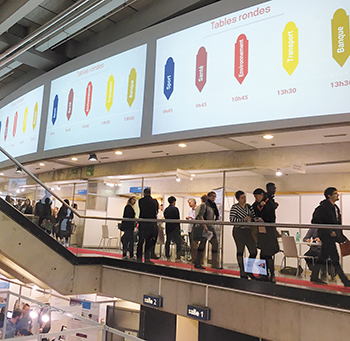
The Mathematics Careers Forum has a very different purpose. FEM 2019, held at the La Villette conference center in Paris, enabled nearly 2,000 students, from the third year of undergraduate study to doctoral level, to meet almost forty companies interested in their profiles, ranging from start-ups to major corporations. The day featured panel discussions, workshops and visits to booths where students could learn about degree programs and opportunities for further study; forty universities attended. A "mathematics programs and careers" area showcased the various career paths open to mathematics graduates. A CV database also made it easier for students and companies to connect.
The SEME, aimed primarily at doctoral and postdoctoral researchers, offer an opportunity to explore innovative mathematical approaches from any field of research, whether or not that field corresponds to the problems submitted by industry. Four to six topics are selected, presented and tackled over the course of a week by groups of four to six early-career researchers from across France. Each group is free to take its work in whatever direction it chooses. The groups present their progress orally on the final day, in the presence of the industry partners. At the Orsay SEME in January 2019, for example, participants considered how to recognize the sound of an aircraft flying overhead (Paris Aéroport and Groupe ADP), how to detect diseases early in cows fitted with sensors (Seenergi), and how to model and forecast the time taken for passengers to board and alight at railway stations (SNCF).
A mission with promising results
-------------------------------------
Since 2011, AMIES has pursued its mission of fostering and raising the profile of relationships between businesses and mathematics laboratories. Beyond AMIES itself, the entire French mathematical community is involved: many collaborations with companies are established directly through laboratories or members of the MSO network. Moreover, master’s degree programs in mathematics have long maintained links with industry through company internships, the growth of work-study programs and contributions from businesses to teaching. Among graduates of master’s degree programmes in mathematics with industry links, three-quarters find employment soon after graduating. The employment rate among PhD graduates in mathematics was 91% in spring 2018, compared with 86% for doctoral graduates across all disciplines one year after defending their dissertations. Of these graduates, 25% worked in the private sector.
For businesses, mathematics plays a major role in innovation—not only through artificial intelligence, for example, but more broadly through the digital economy and Industry 4.0, which require the entire production chain, digital models and even final products to be interconnected. Substantial gains are expected in predictive maintenance, real-time production control and the early detection of deviations, as well as in reducing energy consumption. The associated scientific challenges are numerous: communication security; links between modelling and simulation; management and operation; interoperability between systems and formats…
Meeting these challenges will require many people trained in mathematics!