"Mathematics and society" takes center stage

On the day the 16th Salon Culture et Jeux Mathématiques opens, in May 2015, the entire scientific community is abuzz: AMIES — the Agency for Mathematics in Interaction with Business and Society — together with several mathematics foundations and LaBex, commissioned a study to measure the socio-economic impact of mathematics in France, and its results have just been published. The study reveals the very strong impact of mathematics on the competitiveness and growth of the French economy: 44% of the key technologies identified as such by government reports are heavily influenced by advances in mathematics. The impact on employment is undeniable (15% of GDP and 9% of jobs). Transferring the skills developed by mathematical research to the industrial world emerges as a major societal issue.
The theme of the 2016 Salon was an obvious choice! Five major fields of mathematical expertise have been identified and are expected to be featured: signal processing and image analysis, data mining, modeling-simulation-optimization (MSO), high-performance computing, information systems security and cryptography. The sectors involved range from energy to healthcare, taking in industry and telecommunications.
The Salon is at the forefront of informing young people and the general public about the importance of these exchanges. So in 2016, AMIES and the entire mathematics community will help run a "Maths and Business Area," find speakers for the "Meeting Area," and recruit authors for the magazine Maths et Société Express, which will have a print run of ten thousand copies and be given free to all visitors.
Marie Ekeland: a young and dynamic patron
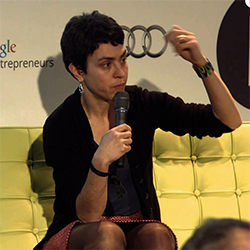
Marie Ekeland, a specialist in mathematics and computer science, approached by AMIES director Stéphane Cordier, agrees to be the Salon's patron. She speaks enthusiastically about careers in computing, about creativity, about "working with your head," about playful activity... Her words will spark enthusiasm and curiosity among the youngest. The Salon wants to rise to a challenge: drawing young men and young women toward scientific careers.
As early as 2014, Jean-Pierre Bourguignon, president of the European Research Council, noted: "We are now seeing the emergence of new professions and new economic models, in which statistics and data processing play an important role." Today, the impact study states: "The state of French research in mathematics potentially constitutes a major competitive advantage for the French economy […]. This overall assessment, highly favorable to mathematics, nevertheless runs up against several weaknesses, such as the insufficient appeal of mathematics teaching programs (stable enrollment figures) and career paths in business that are difficult for young people, and especially for young women, even though job prospects are excellent at the end of this training."
Win-Win Partnerships
--------------------------------
So mathematics is an essential factor in value creation and contributes significantly to the development of the technologies of tomorrow. Yes, but how?
In the energy sector, mathematics plays a key role in modeling system architecture, and then in analyzing and processing the data collected by sensors to forecast energy consumption and optimize distribution networks. In the healthcare sector, mathematics lies at the heart of measuring, analyzing and forecasting the data collected, helping to better monitor patients and better manage their conditions.
In an article for Médiapart, Maria Esteban, president of the International Council for Industrial and Applied Mathematics (ICIAM), writes words that Marie Ekeland would no doubt endorse: "Mathematics plays a fundamental role in economic and technological development, because the problems to be solved in these fields (economics, biology, health, communications, energy...) are written in mathematical language."