



Power of a point
A point and a curve: that's all you need to define a geometric concept of formidable effectiveness, the power of a point. The most well-known case, although absent from today's school curricula, is the power of a point with respect to a circle, or more generally with respect to a conic. Since Antiquity, Euclid could have brought out this concept! Yet one would have to wait until the 19th century for Jakob Steiner to undertake a systematic study of these transformations. The power of a point considerably simplifies the search for geometric loci and leads to the concept of duality, thus opening up vast and new perspectives.
All articles in this folder
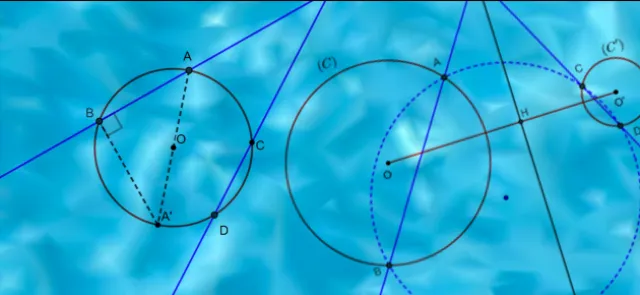
A useful power
Talking about the "power of a point with respect to a circle" may seem old-fashioned nowadays. Yet this elegant geometric notion had its heyday and its uses. Its applications to various mathematical questions are highly fruitful.

In the classroom in the 1960s
In the 1960s curriculum, geometric transformations were studied in some depth. These included, of course, translations (covered in the French seconde, equivalent to tenth grade) and the group they formed.
A concept with a long history
The power of a point with respect to a circle appears implicitly as early as Book III of Euclid's Elements. This notion, elementary as it may be, would be redefined in the 19th century and become the basis for numerous applications in geometry.
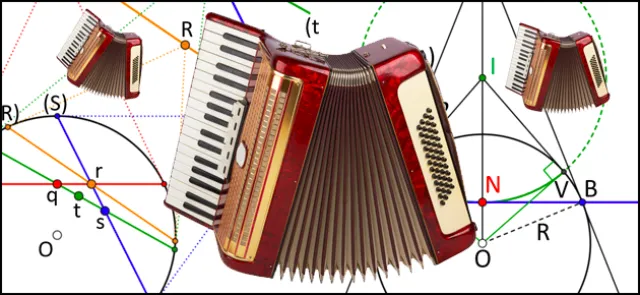
Inverting the power
The notion of power defined with respect to a circle naturally leads to the notions of inversion and polars. These pedagogical tools, which have vanished from school curricula, are central to the birth of the concept of duality and of representations of non-Euclidean geometry.