



Geometric loci
What do the perpendicular bisector of two points, an ellipse, a strophoid or a caustic have in common? These are geometric loci satisfying predefined conditions stemming from purely mathematical considerations or problems drawn from physics. The introduction of analytic geometry followed by differential calculus revolutionized the methods for finding such loci. Ingenious scholars designed mechanisms, specific machines to draw them. The advent of computers transformed the landscape and gave rise to new geometric questions.
All articles in this folder
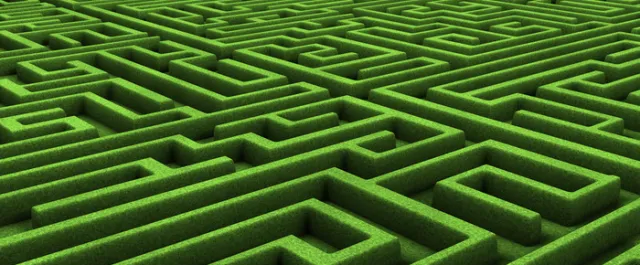
Finding geometric loci: methods | Tangente
Geometric loci: the term has a whiff of grandfather's geometry about it. Nowadays we'd talk about the set of points satisfying a given property. The old terminology gives the problem a more spatial, physical feel. How have the mathematical tools for studying loci evolved?

The circles of Apollonius of Perga: harmonic ratios
The set of points whose ratio of distances to two fixed points A and B is constant is called the Circle of Apollonius. Three ways to approach it: classical geometry, analytic geometry, and electricity
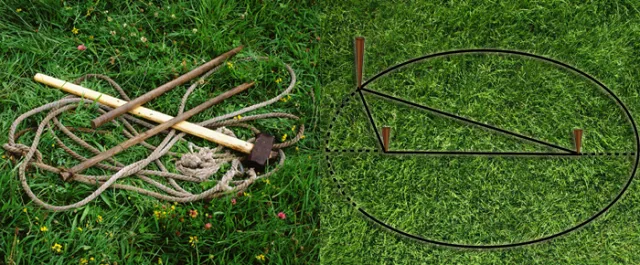
Curva ex machina: mechanisms and curves | Tangente
Do you know Kempe's universality theorem? This 19th-century result states that any algebraic curve can be drawn by a linkage. Today, computers and robotics have replaced the ingenious mechanisms devised by scientists of the past.
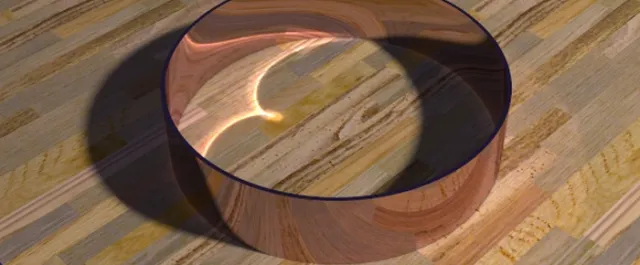
Caustics: curves of light and geometry | Tangente
In optics, the caustic of a curve is the envelope of the light rays emanating from the sun or another source. One appears in your breakfast cup every morning, illuminated by your kitchen or conservatory lights…
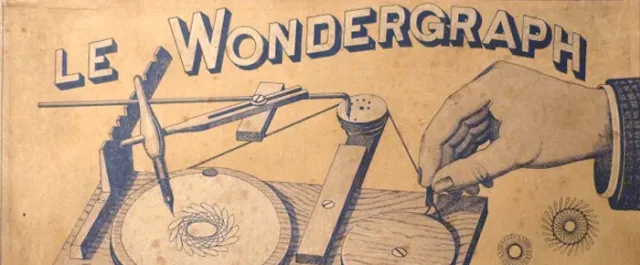
Astounding strophoids: curves and loci
Studied for nearly two centuries before acquiring their final name, strophoids have many interesting properties arising from their similarity under a particular type of transformation. They therefore appear as loci in several classic problems.

Perpendicular bisectors, angle bisectors & beyond | Tangente
Equidistance is introduced very early in geometry. Perpendicular and angle bisectors are the simplest examples. Let us go further and consider points equidistant from a line and a circle, from two circles, or even from two more general curves. How far can we take this?