

The parabola, mirror of the world
With the ellipse and the hyperbola, the parabola is the third non-circular conic section. One might think that its properties are rather banal given that its algebraic equation is one of the simplest. Its definition, too, is elementary: a point and a line are all that is needed to draw it. Yet, it opens up surprising possibilities, whether it's its construction which can prove to be very playful and educational, its tangents which contain many gems, its quadrature which allows for subtle reasoning, not to mention all the theorems related to it or all the applications it generates. Welcome to a universe where a simple curve becomes mirror of the world!
All articles in this folder
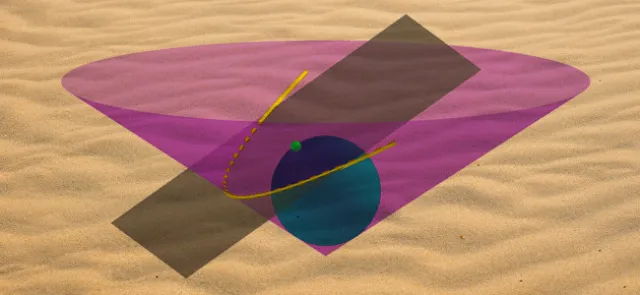
A line, a point, that's all | Tangente
The parabola is one of the simplest curves to define, yet also one of the richest, with properties that make it a flagship object in classical geometry as much as in algebra and analysis. It thus offers an opportunity to bring together different mathematical perspectives.

Constructing a parabola | Tangente
Constructing a parabola is both fun and highly instructive. It brings its geometric properties to life and even provides an opportunity to do some arithmetic.

From Pascal to Poncelet
In the winter of 1812, the retreat from Russia ended in disaster. Jean-Victor Poncelet (1788–1867), a 24-year-old military engineer, was taken prisoner. Steeped in Gaspard Monge's (1746–1818) descriptive geometry, he laid the foundations of modern projective geometry in the prison camps of Saratov, without books or instruments.
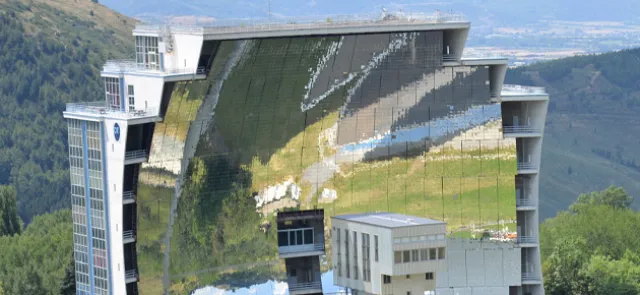
Tangents and the parabola: gems galore
Behind its sleek appearance, the parabola brims with fascinating properties. Thus, the study of its tangents reveals remarkable angular properties and offers a playground of astonishing richness, where classical geometry meets luminous reflections.
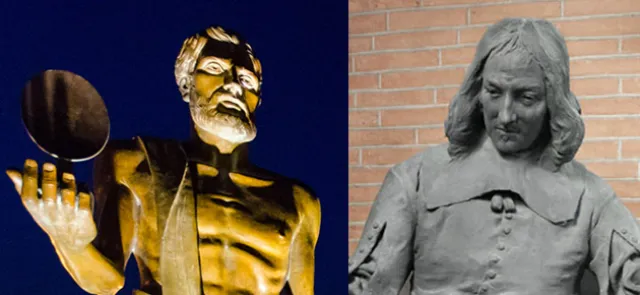
Straightening the curve
The quadrature of the parabola was one of the first triumphs of ancient geometry in the study of areas bounded by curved lines — a success wrested through fierce struggle by Archimedes, before more modern methods simplified and generalized the result.

Celestial parabolas | Tangente
Imagine the Solar System as a collection of different bodies—planets, comets…—subject only to the Sun’s gravitational pull. Classical mechanics then tells us that their orbits can trace only three types of curve: ellipses, hyperbolas and parabolas.

In real life | Tangente
In physics as in architecture, parabolas often appear, whether to model phenomena or provide inspiration.