
Economists often study how quantities evolve over time. They ask how changes in certain key quantities (which they call endogenous) depend on changes in others (called exogenous). For example, we might investigate how a change in the tax rate could affect households’ disposable income.
In the simplest case, at time t, we consider just one endogenous quantity y (t) (the level of income, for example) and one exogenous variable i (t) (such as the tax rate). Mathematically, y (t) is the image of i (t) under a function f that expresses this dependence; hence y (t) = f (i (t)). The function f can also be interpreted as an operator that acts over time on an input function, called an impulse, to produce an output function, known as a response.
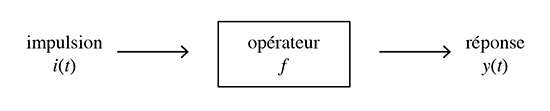
How influence is transmitted within an economic system.
What is the response?
-----------------------