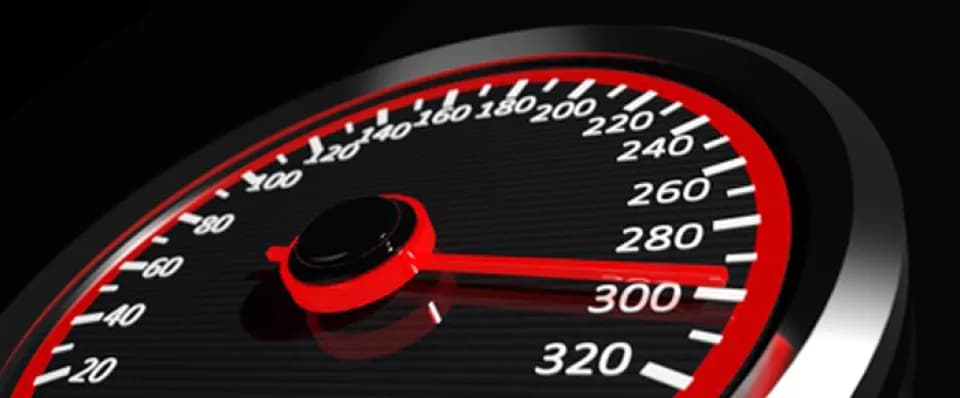
On your way to a holiday destination, you enter a stretch of highway at 9:00 a.m. You leave it two hours later, having traveled 240 kilometers. It is tempting to say that you were driving at 120 km/h, but that figure is only an average speed! It goes without saying that you did not exceed the speed limit. Even so, your speed was surely not constant. So what exactly do the speeds displayed on your dashboard represent?
To make this more concrete, let us consider the speed displayed at 10:00 a.m. As we learn in our early school years, calculating an average speed means dividing the distance traveled by the time taken. This method therefore cannot directly give us the vehicle's speed at exactly 10:00 a.m. We can, however, calculate its average speed from 9:00 to 10:00 a.m., then from 9:30 to 10:00 a.m., then from 9:50 to 10:00 a.m., then from 9:59 to 10:00 a.m.…, making the time interval under consideration shorter and shorter. Of course, if the time interval becomes "smaller and smaller," the distance traveled does too; but what interests us here is the ratio between these two quantities—or, as Isaac Newton wrote, "the ultimate ratio of two vanishing increments."
The instantaneous speed obtained in this way corresponds to the mathematical notion of the derivative at a point.
Toward a generalization
-----------------------
Calculating a car's instantaneous speed can readily be generalized to the study of the most common functions. Let f be a function defined on the set ? of real numbers, and let us try to calculate its derivative at x = 10.