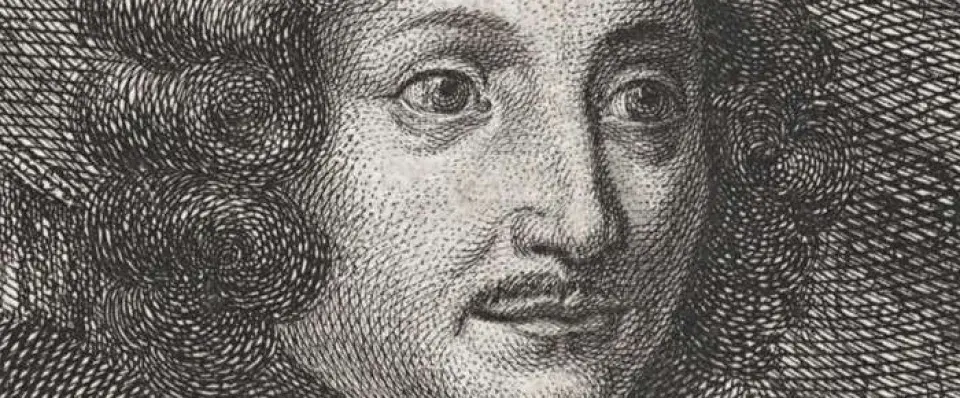
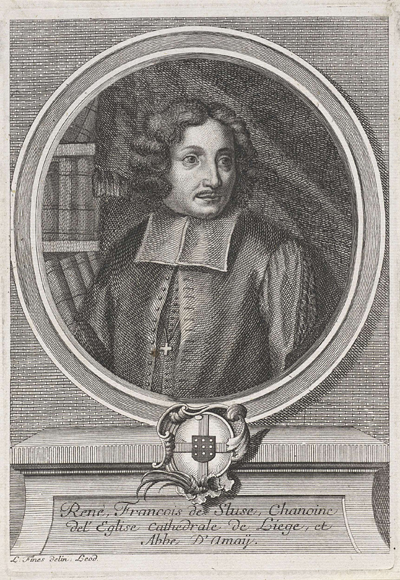
René-François Walter de Sluse (1622–1685), known simply as Sluse, was a clergyman. He spent most of his life along the Meuse near Liège: he was born in Visé, downstream from Liège, served as a canon in Amay, upstream from the same city, and died… in Liège.
Scientifically, Sluse was immensely learned and, like many scholars of his time, highly eclectic: he published works on astronomy, natural history, physics and theology. He was also a gifted mathematician who, according to Léon Rosenfeld (1904–1974), "displayed a quite remarkable capacity for invention and generalization". He maintained an extensive correspondence with several European scholars of his day, including the Frenchman Blaise Pascal, the Dutchman Christiaan Huygens, the Italian Francesco Ricci, the Briton John Wallis and the German Heinrich Oldenburg. Our knowledge of his scientific research comes mainly from these documents, published in 1884 by the Belgian mathematician and historian Constantin Le Paige.
Properties of curves
--------------------
The mathematical subjects that Sluse explored naturally reflected the interests of his time. On the one hand, the 16th century had revived an interest in geometric questions dating back to antiquity. On the other, this was when algebra began to develop in France, first with François Viète, who introduced algebraic notation, and then with René Descartes and his "analytic geometry." The convergence of these two currents led Sluse and some of his contemporaries to investigate the geometric properties of algebraically defined curves.