



Discontinuity
Breaking with the search for regularity in scientific phenomena, the interest in discontinuous functions suddenly appeared at the beginning of the 19th century with the study of Fourier series. Greater rigor was then imposed to define the concepts of function, continuity, differentiability. Riemann, Lebesgue, Darboux and others proposed examples of monstrous functions to justify the interest in the theories they had developed, opening the field to new approaches in physics and even economics.
All articles in this folder
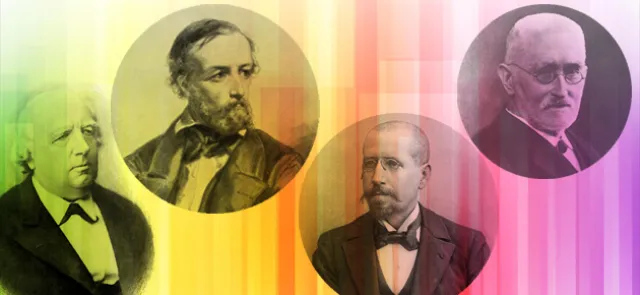
The emergence of discontinuous functions
Until the early 19th century, everything seemed continuous. Trigonometric series brought discontinuous functions onto the scene. They prompted Riemann to generalize the notion of the integral, led Weierstrass to clarify the notion of continuity, and spurred Darboux to study derivatives.

Discontinuities of all kinds
They have been called "pathological"; Henri Poincaré spoke of "monsters," accusing them of being "strange functions that strive to resemble as little as possible the respectable functions that serve some purpose." Yet some discontinuous functions have left their mark on history.
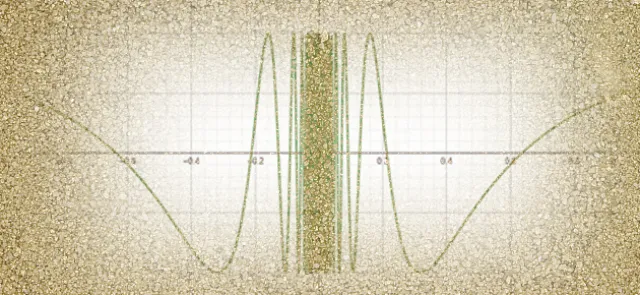
Discontinuities and series of functions
The introduction of series of functions, followed by theorems establishing when continuity or differentiability is preserved in the limit, made it possible to construct objects with unusual, counterintuitive properties. Some famous mathematicians had tremendous fun with them!

The Gibbs phenomenon
When an image is compressed, it not only becomes slightly blurred: wherever there is strong contrast, its discontinuities are accentuated. This is known as the Gibbs phenomenon, and understanding it requires knowing how a wave can be decomposed into harmonics.

Distributions:
The idea of discontinuity is epitomized by two “functions” named after the physicists Heaviside and Dirac. An economic problem offers an opportunity to introduce the fundamentals of the underlying mathematical theory intuitively.