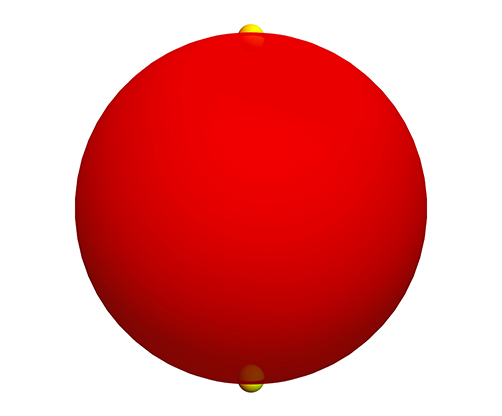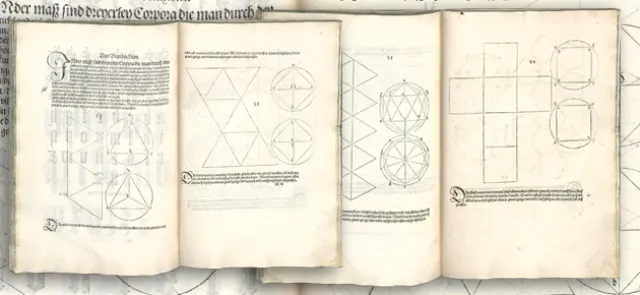
Placing points on a sphere so that they are all as far apart as possible is known as the hostile dictators problem: if dictators wanted to divide up the Earth, they would wish to be as far apart as possible so that they could carve out the largest possible empires! It is also known as the Tammes problem, because in 1930 the Dutch botanist Pieter Merkus Lambertus Tammes (1903–1980) considered how spores are arranged on a pollen grain—a distribution governed by the same rule.
There is no general solution to this problem, although many mathematicians have tackled it, including the Hungarian Laszlo Fejes Tóth (1915–2005); the Dutchman Bartel Leendert van der Waerden (1903–1996), well known for his treatise on algebra; the Briton Harold Scott MacDonald Coxeter (1907–2003); and the Frenchman Marcel Berger (1927–2016). This is the archetypal problem that is easy to state and understandable to anyone, yet still has no general answer—and whose solutions in particular cases can be counterintuitive.
Partial answers
-----------------------
Optimal solutions to the hostile dictators problem are known only for fairly small values of n. For n = 2, it is enough to place two points diametrically opposite each other—for example, at the poles. For n = 3, the solution is to place the three points at the vertices of an equilateral triangle inscribed in a great circle of the sphere.