Making a ping-pong ball could hardly be simpler: two plastic hemispheres are glued together. That is undoubtedly the easiest case to deal with. For most other balls used in sport, however, the geometry is more elaborate. The general idea is often to glue panels onto a spherical rubber core, so that the surface of the ball has the physical properties required for the sport in question.
The basketball's eight panels
-----------------------------------
Have you ever noticed that the outer surface of a basketball consists of eight identical panels? They can be represented on a plane using a rectangular projection.
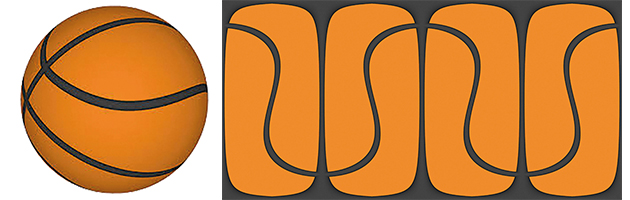
Such a projection is equirectangular: the polar coordinates of latitude and longitude are treated as Cartesian coordinates, with meridians and parallels represented by equally spaced lines. The diagram shows how the basketball's eight outer panels are designed. First, the sphere is divided by two orthogonal great circles. The distortion caused by the rectangular projection makes them difficult to visualize; imagine two great circles drawn along two perpendicular meridians, producing the four orange panels. The diagram also shows a curve dividing each of these panels into two geometrically identical pieces. The equation of this curve involves standard trigonometric functions.