Vladimir Shukhov was born near Belgorod in 1853 into a family of the minor Russian nobility. His father worked in the civil service. He attended secondary school in Saint Petersburg from 1864 to 1871 and proved exceptionally gifted in mathematics: his own proof of the Pythagorean theorem earned him a poor mark for "lack of modesty"!
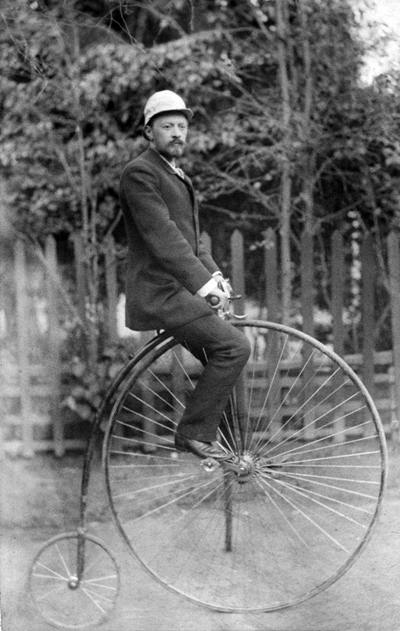
Vladimir Grigoryevich Shukhov (1853–1939).
These outstanding results earned him admission to the renowned Imperial Moscow Technical School (see FOCUS). There he studied under Nikolay Zhukovsky and Pafnuty Chebyshev. Chebyshev encouraged him to pursue mathematics, but Shukhov preferred to apply his knowledge to designing industrial structures.
He travelled to Philadelphia to help design the Russian pavilion for the 1876 World's Fair, held to mark the centenary of the Declaration of Independence. There he met Alexander Bari, a Russian-born American entrepreneur, who hired him and sent him to Baku—now the capital of Azerbaijan—to oversee oil operations. Shukhov developed practical methods for calculating how different materials deform according to their shape. This enabled him to design oil pipelines and tankers. In November 1891, he invented the first method for the thermal cracking of petroleum.