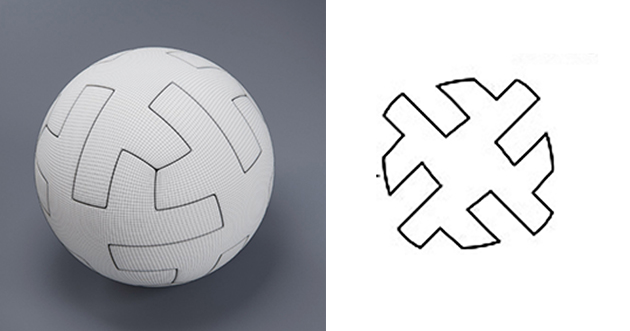
Over the World Cup's eighty-year history, footballs have changed considerably: T-shape and Tiento, in 1930, were made from twelve T-shaped panels; the 1934 Federale 102 had thirteen, while the 1950 Superball was back to twelve. After eighteen-faced balls through 1962, the number rose to twenty-five in 1966, before reaching the thirty-two faces of the truncated icosahedron in 1970: twenty hexagonal faces and twelve pentagonal ones. With its black pentagons and white hexagons, this first-generation Telstar became a star of black-and-white television.
Footballs frequently changed names and took on new colors, but retained the same shape until 2006. Then the Teamgeist had fourteen panels, the bouncy 2010 Jabula had just eight, and from 2010 onward footballs became… "cubic." They are round, of course, but have the structure of a cube: six faces, each with angles of less than 120°, fitted together three at a time around every vertex and on a sphere. A mathematical result, the Alexandrov–Pogorelov theorem, says that such an assembly is possible. These two Russian mathematicians—Alexandrov in 1950 and Pogorelov in 1970—generalized the theorem that Cauchy stated in 1813: "Every convex polyhedron is rigid." In other words, under certain conditions, six convex regions can be joined together as the faces of a cube would be, forming a kind of polyhedron with faces that are not quite flat, which forms a sphere when inflated. Through this miracle of geometry, the Brazuca was born in 2014, followed by today's ball, the Telstar 18.