How can we tell that a star is "larger" than the Moon? By establishing that it is "much" farther away! But we cannot simply take out a tape measure and stretch it between celestial objects. We need to be clever and work outward step by step. First, we determine the distance to a relatively nearby object. We then use that knowledge to infer the distance to one a little farther away. This principle is known as the distance ladder: at each stage, we stand on the previous rung to reach the next. The first rung on the distance ladder is Earth's diameter.
Earth's diameter
-----------------------
The earliest known text to describe the Earth as round is the Rig-Veda, a sacred Hindu text dating from around 1500 BCE.
In ancient Greece, Aristotle (384–322 BCE) proved that the Earth is round by observing the shape of its shadow during lunar eclipses.
In short, Eratosthenes (c. 276–c. 194 BCE) had no doubt that the Earth was round. With that knowledge, he set out to measure its circumference.
There is said to have been a well at Syene, in the south of modern-day Egypt, whose bottom was illuminated by the Sun at noon on the summer solstice. Assuming that the well had been dug vertically, the Sun must therefore have been at the zenith at noon. In fact, Syene lies on the twenty-fourth parallel, so not quite on the tropic, but not far from it.
Eratosthenes estimated that Alexandria, in northern Egypt, lay on the same meridian as Syene. On the day of the solstice, he used a gnomon (a straight stick planted vertically, whose shadow on the ground can be tracked and measured) to determine the angle between the Sun's rays and the vertical. He measured an angle of 7°.
If we assume that the Sun S is "infinitely far" from the Earth, then the rays from S reaching Syene are parallel to those reaching Alexandria. The angle between the Sun's rays and the gnomon in Alexandria is therefore equal to the angle formed by Syene, the center of the Earth and Alexandria (both angles are shown in dark red in the diagram).
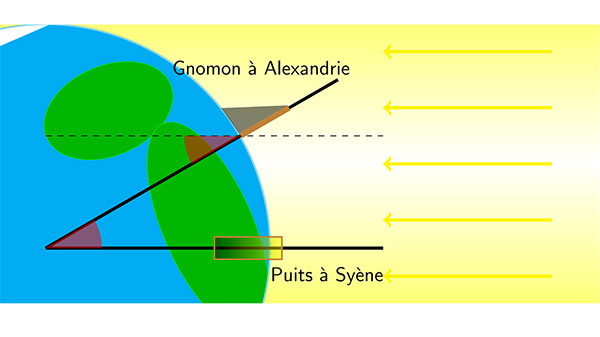
Knowing that Syene and Alexandria are 5,000 stadia apart, he used a proportion to deduce that the Earth's circumference was (5,000 × 360) / 7, or 250,000 stadia.
Unfortunately, we do not know the exact length of the stadion, which in any case varied from place to place, but 250,000 stadia are estimated to be about 40,000 kilometers. Since a circle's circumference is π times its diameter, this gives the Earth a radius of 6,500 km. Today, we know that the Earth's mean radius is 6,371 km. Despite the approximations he had to make, Eratosthenes was therefore not far from the exact value!
Reaching for the Moon
-----------------
Once the Earth's diameter is known, the diameter of the Moon's orbit can be determined! In 270 BCE, Aristarchus had observed that a lunar eclipse lasts at most three hours and that the Moon's apparent diameter is 0.5°.
A lunar eclipse occurs when the Moon (L) passes through the Earth's shadow. If the Sun is "sufficiently far away," all the rays reaching the Earth are parallel to one another. The diameter of the Earth's shadow is then equal to the Earth's radius.
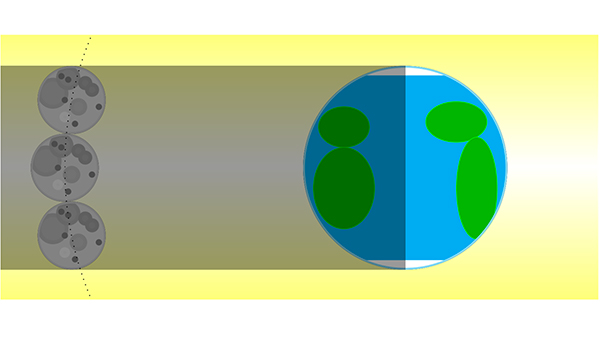
Since the Moon takes three hours to travel one Earth radius, a proportion tells us that it travels (27 days × 24 hours) / 3 hours = 216 Earth diameters per orbit. In other words, the circumference of the Moon's orbit is 216 Earth diameters. A circle's circumference is π times its diameter. The diameter of L's orbit is therefore about 70 Earth diameters (which makes it clear that the diagram is far from being to scale!).
Aristarchus thus calculated that the Moon was 450,000 km from the Earth, whereas the exact value is 380,000 km. Despite the approximations he used, Aristarchus had therefore obtained the correct order of magnitude. In particular:
• his estimate of T's radius was not exact;
• the Earth's shadow is a cone, not a cylinder.
The Sun… or perhaps not
-----------------
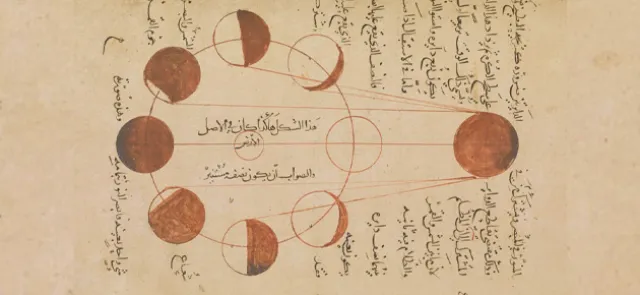
Once he knew the Earth–Moon distance, Aristarchus set out to measure the Earth–Sun distance. He came up with a rather ingenious idea: when line (TL) is perpendicular to line (TS), the Moon appears slightly more than half illuminated. In other words, when an observer on the Earth's night side sees the Moon exactly half illuminated, the angle formed by the Moon, the Earth and the Sun is less than 90°.
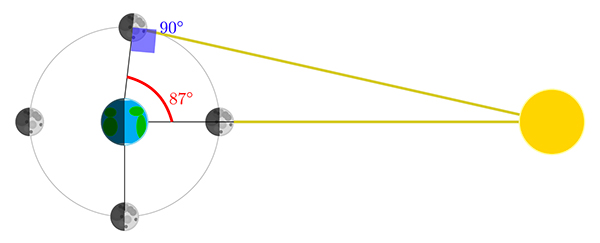
We then need only measure this angle and use a little trigonometry to determine the distance TS. Aristarchus estimated the angle to be 87°. At quarter Moon, triangle TLS gives:
According to Aristarchus, S was therefore twenty times as far from T as L was, corresponding to an Earth–Sun distance of nine million kilometers.
Aristarchus's method was interesting, but his estimate was inaccurate: the angle formed by the Sun, the Earth and the Moon is actually 89.85°. Measuring this angle is no easy task: the Moon's surface is not smooth, so the terminator is not a straight line segment, and the Sun is not visible in the sky when the measurement is taken. Furthermore, because the cosine of the angle is used, this error of less than 3° translates into an error of more than 100 million kilometers! The Sun is therefore much farther from the Earth than Aristarchus thought.
Once Aristarchus had calculated the distance TS, he used that information to determine the Sun's diameter. Knowing that the Moon and the Sun have the same apparent diameter in the sky, and believing that the latter was twenty times farther from us than the former, he applied the intercept theorem to deduce that the Sun was twenty times larger than the Moon. He then wondered why the Sun should orbit the Earth rather than the other way around, since the Sun was larger. In short, a little observation and geometry enabled him to challenge the geocentric model.
Reaching the planets
--------------------
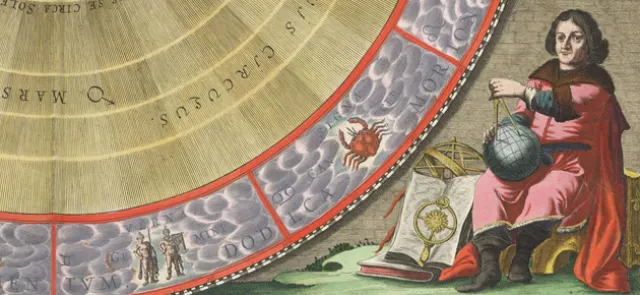
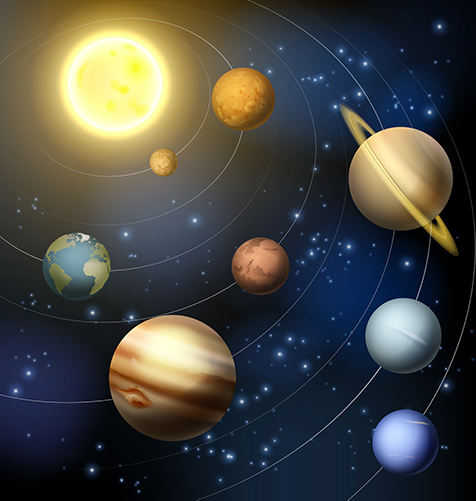
It was Copernicus, around 1543, who provided the key to measuring the distances to the planets. Since all the planets orbit the Sun, we need only measure the angle θ on the celestial sphere between S and the planet under study. For an inner planet such as Venus (V), the angle θ is greatest when the angle formed by S, V and T is a right angle. We then have sin(θ) = SV / ST.
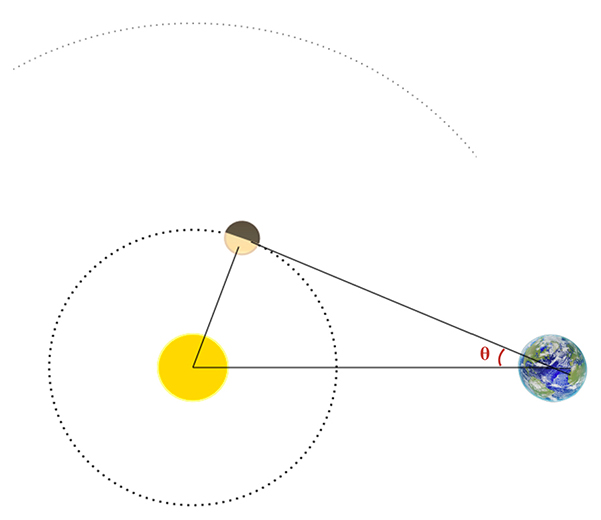
However, if we do not know the distance between the Earth and the Sun, this gives us only part of the equation. Since this distance could not yet be determined, a new unit of measurement was introduced: the astronomical unit (AU), equal to the mean distance between the Earth and the Sun. Even without knowing how many kilometers there are in an astronomical unit, we can still express the distances of the planets in AU.
The transit of Venus
-------------------
In the 17th century, Johannes Kepler applied his model of planetary orbits to the Earth and determined that if the Sun were only ten million kilometers away, as Aristarchus's model predicted, we should see apparent motions of the Sun that are not in fact observed. He concluded that Aristarchus had underestimated the distance TS.
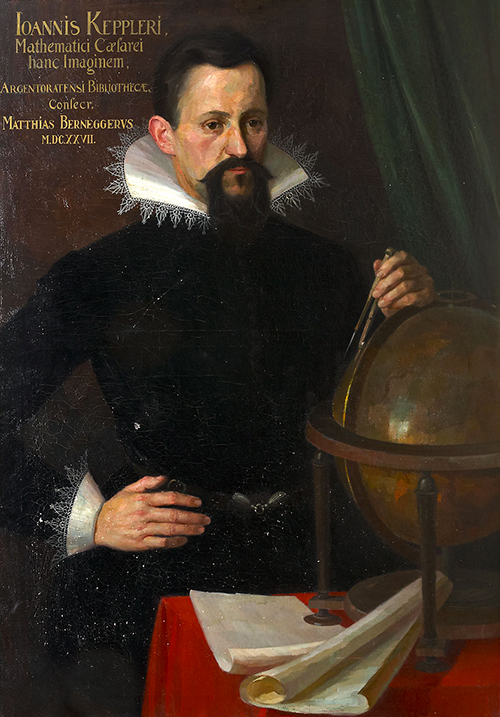
Johannes Kepler (1571–1630).
Many scientists subsequently attempted to measure the distance TS, producing estimates that varied by a factor of one hundred! Only in the 18th century did the estimates begin to converge.
A transit is the passage of a star or planet in front of another celestial body—for example, when Venus or Mercury passes directly between the Sun and the Earth. The planet can then be seen obscuring part of the Sun's disk.
At the very beginning of the 17th century, the astronomer Edmond Halley (1656–1742) was greatly impressed by his observation of a transit of Mercury. The event gave him much food for thought; he published an article explaining how a planetary transit could be used to determine the value of the astronomical unit.
For the 1761 transit of Venus, several expeditions were organized to observe the event from different locations on Earth. More than two hundred astronomers observed the phenomenon. In a sense, it was the first major international scientific collaboration.
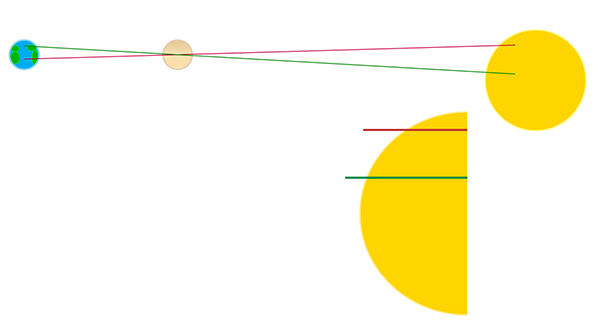
Depending on where we are on Earth, Venus does not transit across the same part of the Sun's disk. The phenomenon therefore lasts for different lengths of time. By comparing the duration of the transit at different locations, we can determine the value of the astronomical unit!
From Earth, Venus will be seen passing across the Sun's disk, but not all observers will see Venus in the same position relative to the Sun. In the diagram, the astronomer in the Southern Hemisphere will see Venus travel along the red line segment, while the observer in the Northern Hemisphere will see it follow the green line segment.
Following the 1761 transit, Johann Franz Encke calculated an Earth–Sun distance of 153 million kilometers, very close to the 140 million kilometers accepted today.
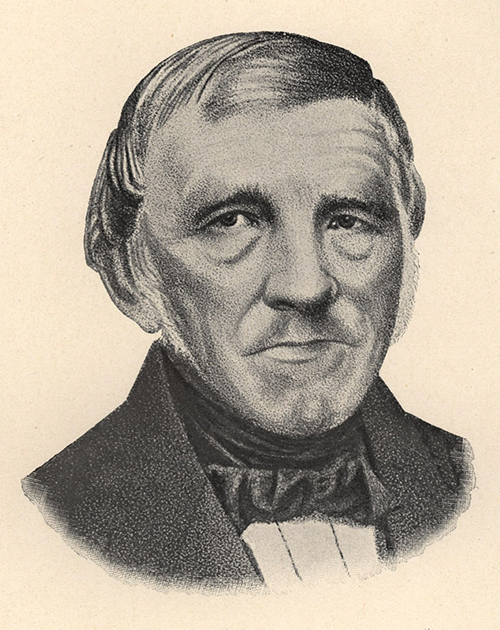
Johann Franz Encke (1791–1895).
These observations from 1761 did not provide very conclusive evidence for determining the value of the astronomical unit, as measurement errors were still fairly large. They did, however, allow astronomers to prepare for the 1769 transit of Venus. Above all, the 1761 event marked the beginning of the convergence between the various estimates of the Earth–Sun distance.
Over the following years, the various estimates drew ever closer together, until there was barely any room between them. A scientific consensus on the value of the astronomical unit was finally reached.
With the Earth–Sun distance known, we can at last determine precisely the distance from Earth to every planet.
Today, we have more sophisticated technology for measuring distances to objects in the solar system. Reflectors placed on the Moon have revealed that the Moon is receding from Earth by 4 cm each year.
The distance to the Sun is measured very precisely by radar. This has strengthened our knowledge of the solar system!
This article won the Tangente Prize for Best Article in 2021.