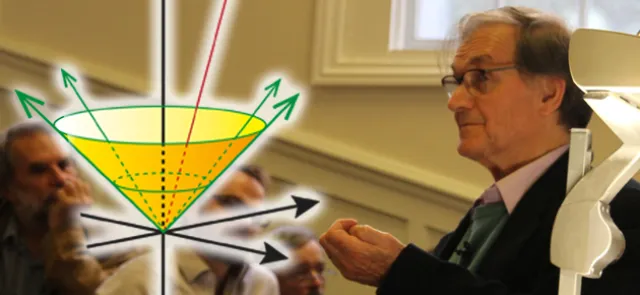
As formulated in 1905, special relativity irrevocably upended long-held ideas about time. The term "relativity" is, of course, associated with Einstein, who gave the theory its modern form. In a sense, however, the idea had already appeared in Galileo's writings three centuries earlier.
Galilean relativity is based on the observation that we cannot sense that we are moving when we travel "in a straight line at constant speed." We can experience this every day on a moving train: when there are no jolts, passengers feel as though they were stationary. In theoretical terms, this means that there is no privileged frame of reference in the universe: no mechanical phenomenon can distinguish one frame from those moving uniformly in a straight line relative to it.
No absolute frame of reference
===========================================================================
Maxwell's equations of electromagnetism led Einstein to realize that the relativity of motion applies to electromagnetic phenomena as well as mechanical ones. But if electromagnetic phenomena likewise cannot tell us whether we are on the train or the platform, a beam of light must appear to travel at the same speed in both situations—even if, say, the train is moving in the same direction as the beam. Intuitively, we might expect the passenger to see the light moving more slowly in that case.
The general explanation is that time does not pass in the same way on the platform and aboard the train: each observer has their own "proper time," which they use to measure speeds, and neither is "better" or "more valid" than the other.