



Relativity
The arrival of relativistic theories imagined by Albert Einstein at the beginning of the 20th century overturned our understanding of the universe. The equations of the new model hold their share of mathematical surprises, and therefore of fascination. Gravity becomes a manifestation of geometry, non-Euclidean spaces impose themselves, the formation of theoretical singularities suggests the discovery of black holes and other very concrete objects, tensors impose new formalisms… A new world, where cosmology is based on mathematics, enriches itself day by day and it is far from having revealed all its secrets!
All articles in this folder
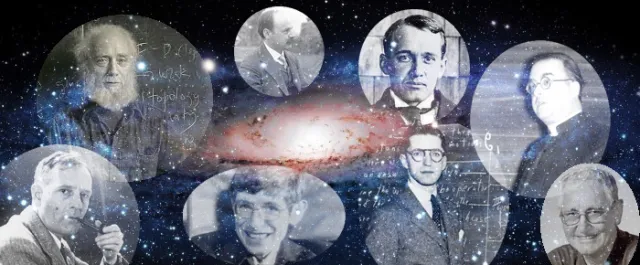
How the universe became a physical object | Tangente
The history of our universe did not take shape overnight. It took centuries to emerge and prevail amid controversies, competing models and apparent inconsistencies. Casting cosmological phenomena into equations, together with observations, brought matters into focus.

Minkowski space and relativity | Tangente
How can the "strangeness" of relativity be described geometrically? By introducing a time dimension and mathematically redefining distance, Minkowski space provides the rigorous framework we need.

The puzzles of general relativity
Newton's laws quickly reach their limits when applied to certain celestial phenomena. Reconciling theory with observation requires the introduction of "spacetime with a changing geometry"…
The tensor: an indispensable tool
Describing the universe as a whole calls for a rather abstract mathematical concept: the tensor. Einstein's equation, which links geometry to the distribution of mass in the universe, makes use of tensors to express this relationship very concisely.