An individual or entity has free will at time t if its state cannot be described as the result of applying a function, in the mathematical sense, to the state of the Universe before time t. This amounts to a kind of "functional indeterminism." The theorem is based on two axioms related to quantum mechanics, called Spin and Twin, and Min, an axiom related to relativity.
Lines emerging from a die
-------------------------------
To introduce Spin, begin by drawing, on each face of a cube, a square with the same center as the face and sides parallel to its edges. Keep the vertices, the center and the midpoints of the square's sides, giving nine points in all. Across the cube's six faces, this gives fifty-four points. Adding the midpoints of the cube's twelve edges brings the total to sixty-six. But we need retain only thirty-three, since every point in the collection has a reflection through the center of the cube, and the two points lie on the same axis.
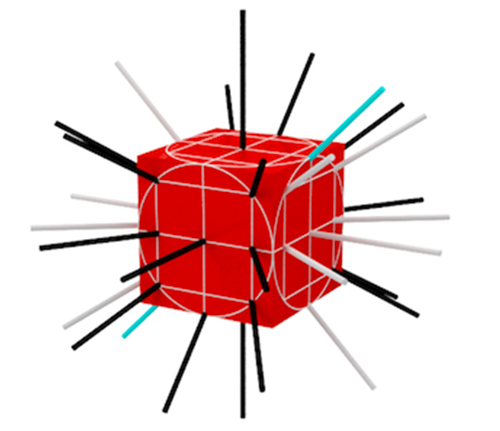
Now consider the thirty-three distinct axes. There is no way to assign each of them a value of 0 or 1 so that every triple of mutually orthogonal axes is assigned the values (0, 1, 1), in any order. This result is a priori surprising, since there are exactly 233 possible assignments—more than 8.5 billion.