Journeys among numbers
-------------------------
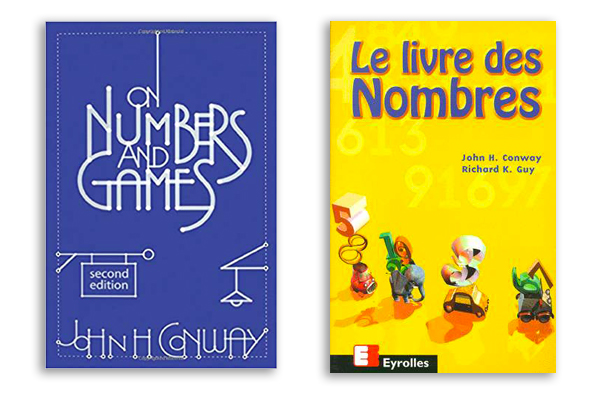
Following the enormous success of the Game of Life, Conway published On Numbers and Games (Academic Press) in 1976; it was republished in 2001 by AK Peters. The writing is straightforward and humorous, and some chapters are accessible to non-mathematicians. Although Conway alone is credited as the author, the book is known to have grown out of extensive discussions with Martin Gardner (see Tangente 136, 2010). The first part of this seminal work on combinatorial game theory, amusingly entitled Zerothpart ("Part Zero"), is devoted to... numbers, particularly surreal numbers. First part looks more closely at two-player games whose players are named Right and Left, and reflects on the numbers that pervade them.
In 1995, John Conway and his friend Richard Kenneth Guy (1916–2020), who also died recently, published The Book of Numbers. The two companions take us on a fantastic journey through numbers, from integers to transcendental numbers by way of imaginary numbers. It is the only Conway book translated into French (Le Livre des nombres, Eyrolles, 1998), but sadly it is now out of print for good.
The three musketeers of combinatorial game theory
------------------------------------------------------------
Martin Gardner is well known for his many talents and his campaigning against pseudoscience. But his great fame came from the mathematical-recreation column he wrote for Scientific American. His passion for mathematical diversions brought him into contact with John Conway and two other outstanding mathematicians, Elwyn Ralph Berlekamp (1940–2019) and Richard Guy. Berlekamp was one of the founders of combinatorial game theory and devised error-correcting algorithms. Guy, meanwhile, specialized in game theory and graph theory.
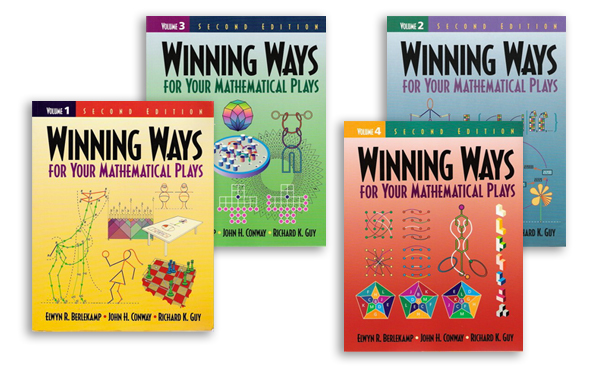
All three shared a close friendship with Gardner and, of course, a passion for mathematical games and the magic of numbers. They pooled their talents and expertise to write Winning Ways for Your Mathematical Plays. together in 1982. The first edition (Academic Press) consists of two volumes examining games from both theoretical and practical perspectives. The first lays the foundations of combinatorial game theory; the second describes various games with unconventional rules. The second edition (AK Peters, 2001–2004) includes two additional volumes: the third presents new games, while the final volume explores a variety of puzzles.
With Gardner as D'Artagnan, Conway, Berlekamp and Guy were the three musketeers of combinatorial game theory.
The more serious works
-------------------------
The success of Conway's books on games might overshadow the fact that he also published works of pure mathematics of fundamental importance. Drawing on his studies of Leech lattices and his discovery of the groups that now bear his name, Conway co-authored Sphere Packings, Lattices and Groups (Springer) with Neil James Alexander Sloane in 1988, a standard reference on sphere packing.
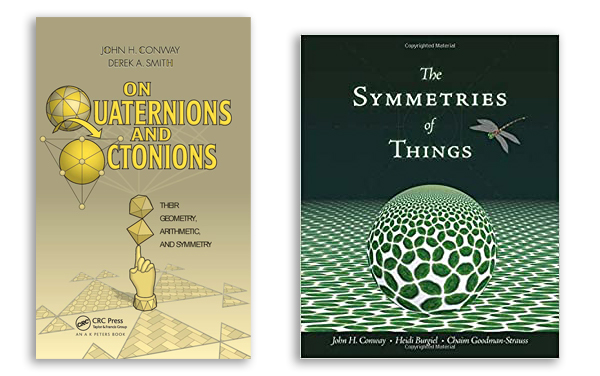
On Quaternions and Octonions (AK Peters and CRC Press, 2003), written with his student Derek Alan Smith, explores fascinating geometric properties of these algebras. Quaternions and octonions are noncommutative algebras of dimensions 4 and 8 respectively, and the latter is not even associative.
In the masterly Symmetries of Things (AK Peters and CRC Press, 2008), written with Heidi Louise Burgiel and Chaim Goodman-Strauss, Conway returns to his passion for symmetries, adopting an approach that makes the opening chapters widely accessible (see Découpages et Pavages, Bibliothèque Tangente 64, 2018).
John Conway was also one of the authors, alongside Robert Turner Curtis, Simon Philips Norton, Richard Parker and Robert Arnott Wilson, of the ATLAS of Finite Groups, published in 1985 and subsequently corrected and reissued. This standard reference sparked debate in 2015 over the reproducibility of certain tables requiring extensive computation. Independent checks have since confirmed all the published results.