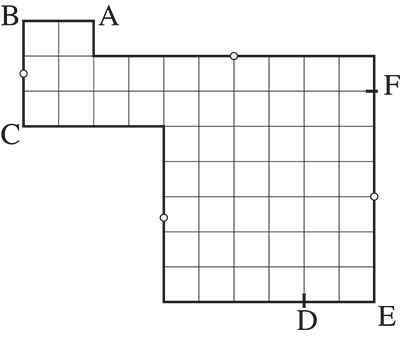
John Conway studied tilings of the plane (see Découpages et Pavages, Bibliothèque Tangente 64, 2018, for an introduction to some of his major contributions). In particular, he proposed a sufficient, though not necessarily necessary, condition for a simple polygon to tile the plane (the "polygon" may also have curved edges).
Mark six points A, B, C, D, E and F, in that order, on the boundary of the polygon, such that:
• the boundary portions [AB] and [DE] are translates of one another;
• each of the boundary sections [BC], [CD], [EF] and [FA] has a center of symmetry (here [CD] and [FA] denote unions of line segments, not single line segments);
• at least three of the six points A, B, C, D, E and F are distinct.
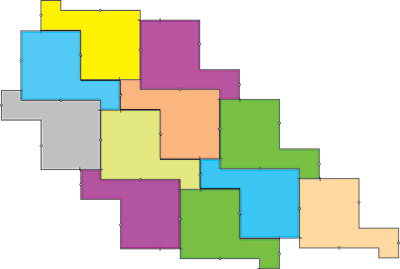
The "tile" shown below can then be used to produce a tiling involving only translations and rotations through 180°.