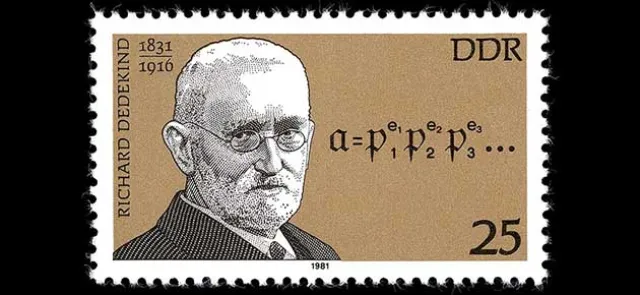
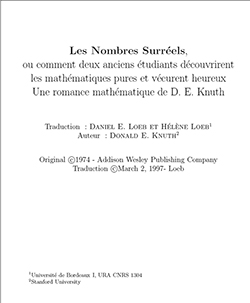
How can we construct the largest possible collection of numbers? John Conway answered this question by starting from an idea of the American mathematician Donald Knuth (born in 1938) and drawing inspiration from the notion of a cut, introduced by the German mathematician Julius Wilhelm Richard Dedekind (1831–1916). Dedekind proposed a rigorous construction of all the real numbers from the more manageable set of rational numbers. This transition is not as straightforward as it might first appear, since it involves passing from countable infinity to the infinity of the continuum. A cut in Dedekind's sense consists of two sets of numbers, with every element of the first set strictly less than every element of the second. The classic example of a Dedekind cut is the construction of the number . The first set (A) consists of the negative rational numbers together with all rational numbers whose square is strictly less than 2. The second set (B) consists of all positive rational numbers whose square is greater than or equal to two. Dedekind's idea was to define a real number as a pair of sets of rational numbers. The number is thus defined as the pair of sets (A, B). A similar idea would lead John Conway to define the collection of surreal numbers.
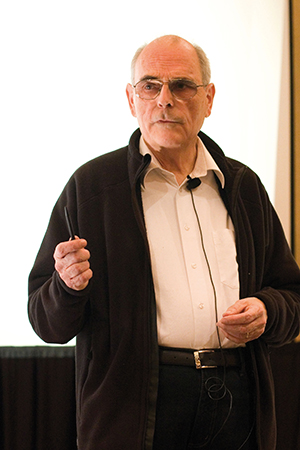
Donald Ervin Knuth (born in 1938).
Drawing inspiration from cuts
-----------------------