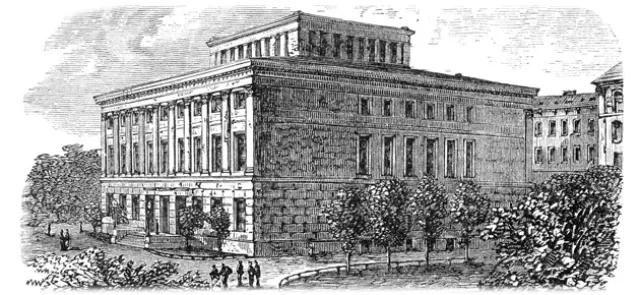
Richard Dedekind was born in Brunswick, northern Germany, on October 6, 1831. In 1848, he enrolled at Brunswick's Collegium Carolinum, then a post-secondary preparatory college. He studied mathematics there before continuing his education at the University of Göttingen in 1850. In 1854, he earned a doctorate in mathematics under the great Carl Friedrich Gauss (1777–1855), who had remarkably few students under his direct supervision over the course of his long career.
Two decisive encounters
--------------------------
Following German tradition, Dedekind then worked toward a Habilitation, which would allow him to teach at universities. At Göttingen, he became friends with another of Gauss's students, arguably the most brilliant of them all: Bernhard Riemann (1826–1866), who profoundly influenced and inspired him. Dedekind wanted to do for number theory what Riemann had done for function theory: develop mathematics by emphasizing concepts rather than relying on computations.
Dedekind's second decisive encounter was with Johann Gustav Peter Lejeune-Dirichlet (1805–1859), who came from Berlin in 1855 to take the chair left vacant by Gauss's death. A leading number theorist, Dirichlet transformed the teaching of mathematics at Göttingen and became friends with Dedekind, who wrote that "through both his teaching and many personal conversations [… Dirichlet] made [him] a new man." Dedekind then turned to number theory and devoted more than fifty years to it.
From number theory...
----------------------------