



What mathematics owes to physics...and vice versa
In the history of the development of scientific thought, it is often difficult to distinguish what belongs to mathematics from what is initiated by physics. Scholars rarely confined themselves to a single field at that time. The role of mathematics then evolves, as the physicist changes paradigm: calculation tool, reservoir of models, predictive instrument… From the method of exhaustion already used by Archimedes to the Fourier and Maxwell equations, the examples to explore are numerous.
All articles in this folder
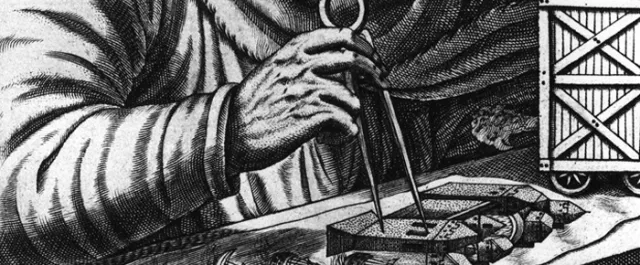
The geometry of measurement
The concept of measurement evolved over a long period, from concrete practice to abstraction, in a process initiated by Archimedes. This required mastering the concept of infinity.
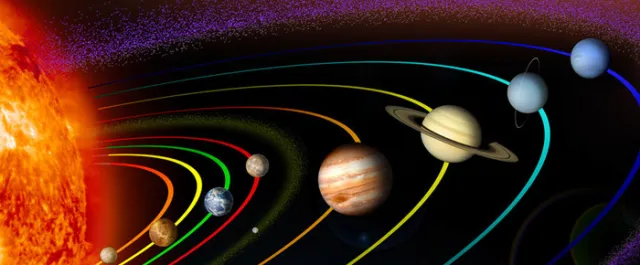
Newton's fluxions
With his theory of fluxions, Newton explained Kepler's laws describing planetary motion. Yet because it was less convenient to use than Leibniz's infinitesimal calculus, it ultimately held back research in Britain.

A controversy over gears
What shape should gear teeth have to get the most out of gears? The question preoccupied 17th-century scholars so intensely that tempers sometimes flared. Philippe de La Hire and Gottfried Wilhelm Leibniz were two of the protagonists in this historic scientific dispute.

Claude Mydorge:
A keen enthusiast for geometry, Claude Mydorge collaborated with René Descartes. His interest in conic sections led him to study the laws of optics and astronomy. He also developed a particular fondness for mathematical games and recreations.

Joseph Fourier
At a time when the nature of heat was still being debated in the 18th century, Joseph Fourier established an equation describing how heat propagates through a solid of arbitrary shape. His methods make the French scientist a founder of mathematical physics.
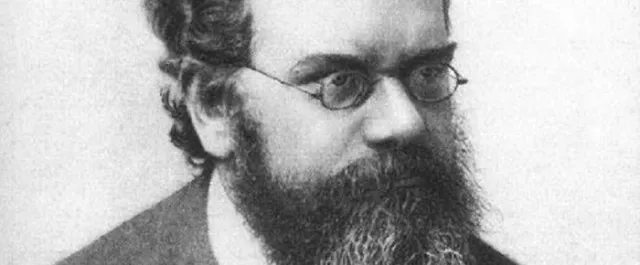
Ludwig Boltzmann
Ludwig Boltzmann was one of the most important scientists of the 19th century. Boltzmann's interpretation of entropy inspired Max Planck and Albert Einstein in their work on the statistical theory of radiation and on the quantum and photon hypotheses.
James Clerk Maxwell
In 1865, with four equations that have since become legendary, Maxwell unifies magnetism, electricity and optics—fields that had until then remained separate. The way is now open for wireless telegraphy, radio broadcasting and, later, the development of electronics.

Approximations in physics | Tangente
They trouble mathematicians, for whom sin(x) can never equal x when x is a nonzero but "small" real number. Yet they are useful! "They"? Approximations!