A fable
---------
*

*Once upon a time, there was a physicist studying natural phenomena who was having a terrible time making headway. Then, one fine day, like Zorro, a specialist from another field—a mathematician—came along and gave him the tools to get out of the rut.
This picture may hold true for a number of disciplines, in both the exact sciences and the humanities, but when it comes to physics, it is pure fantasy. Discoveries in the two disciplines have always been closely intertwined, so much so that it has often been impossible to tell whether the needs of physics drove mathematicians to explore new concepts or whether, conversely, mathematical knowledge revealed unsuspected results in physics.
-
A debate
--------
Two views coexist.
– Mathematics is the language of nature.
Einstein: "Our experience thus far entitles us to believe that nature is the realization of the simplest thing that can be conceived mathematically. I am convinced that purely mathematical construction enables us to discover the concepts and the principles connecting them, which give us the key to understanding natural phenomena."
– Mathematics is the language of humankind.
Heisenberg: "Mathematical formulas do not represent nature, but our knowledge of it".
As far back as antiquity, Aristotle maintained that mathematical entities exist in the intellect only as abstractions drawn from the sensations produced in us by physical objects, or "bodies." What is abstracted away—and what characterizes physical objects—is motion or change.
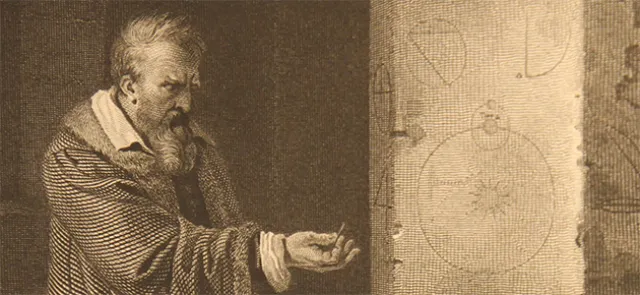
Nearly two thousand years later, Galileo would say: "We cannot understand the universe unless we first learn the language and recognize the characters in which it is written. It is written in the language of mathematics, and its characters are triangles, circles, and other geometric figures..."
The 20th century brought no change: astrophysicist James Hopwood Jeans declared, "The Great Architect seems to be a mathematician."
Physicist Paul Langevin seemed almost embarrassed by the fact: "It is remarkable that, among the abstract structures developed by mathematics under the sole guidance of its need for logical perfection and ever greater generality, none seems destined to remain useless to physicists. Through a singular harmony, the needs of physicists seeking to construct an adequate representation of reality seem to have been anticipated and outstripped by the mathematician's logical analysis and abstract aesthetic sensibility."
-
New branches of physics
------------------------------------
When calls arose for a "more intuitive," "less mathematical" physics, an intermediate field between physics and mathematics became essential: mathematical physics, which focuses on formal aspects. Its role is to study physical theories already fully developed by theoretical physics and ensure their mathematical consistency.
This does not mean, however, that everything in physics is now explained mathematically.
In quantum mechanics, mathematical methods bog down when complex structures are involved.
In fluid mechanics, many empirical laws have no explicit mathematical expression.
We may suppose that the correspondence is intrinsic but has not yet been brought to light, either because we have not yet managed to match the physical law with a mathematical theory or because the applicable mathematical theory does not yet exist...
A second special issue of Tangente, devoted to the modern development of mathematical physics, will be published in early summer 2019.