On June 1st, 2019, Michel Serres died (see Tangente 189). He described himself as a "scientist turned philosopher". He had in fact begun by studying mathematics, then attended the École Navale, before changing course—no doubt influenced by personal questions about science in the wake of the tragedy of Hiroshima—and entering the École normale supérieure (ENS) to study literature. He went on to become the well-known philosopher and historian of science who delighted audiences through his media appearances and numerous books. His early affinity for mathematics kept him close to the field, and mathematical touchstones recur throughout his philosophical work, both in his talks and in his publications.
Leibniz, the starting point
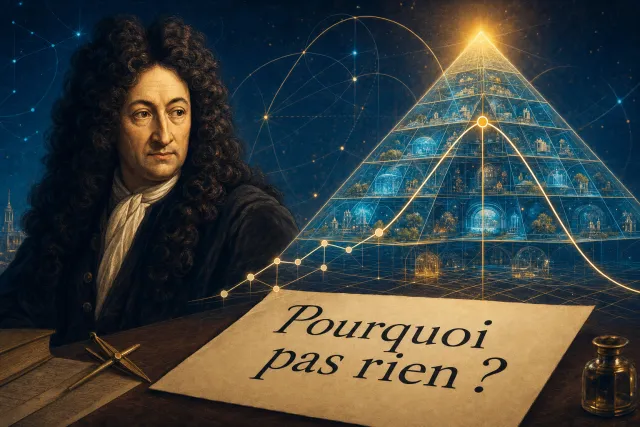
Michel Serres chose the German philosopher and mathematician Gottfried Wilhelm Leibniz (1646–1716) as the subject of his doctoral thesis in philosophy, published by the Presses universitaires de France in 1968 because, as he put it, "Leibniz belongs to our time; he is our predecessor. He began building the world we live in and recognized it before we did, better than we do."
Under the title Le Système de Leibniz et ses modèles mathématiques, he scrutinized the work of his illustrious predecessor and, despite the German philosopher's reputation for ranging far and wide, uncovered a perfectly coherent system, which he brought to light in his own way. "The density of metaphysical language makes this reading \[of a universal language\] less straightforward than one might think \[…\]. To clarify the problem, one principle is essential: working back from the paradigms \[the models\] to the structure \[…\]. One could then choose models in a thousand fields \[…\]. Instead, we chose to reduce matters to their simplest form and select a succession of mathematical theories." In three parts—"Stars," "The language of diagrams," and "The fixed point"—Michel Serres thus set out to show that the freedom to devise different paths, already present in Leibniz's philosophy, also informed his mathematical innovations. As he asserted, "Throughout his scientific work, one recognizes his acute awareness of changes in order, variations and restructurings."