We perceive an object's outlines and distinctive features thanks to a "trick" of our visual system that scientists call lateral inhibition: a clever perceptual process that enhances the contrasts in an image like a high-pass filter, thereby bringing its outlines into relief.
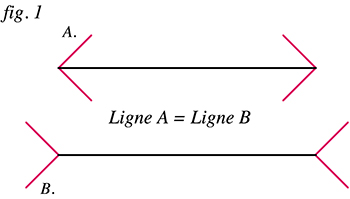
A straight line is a line under tension: it is the shortest path between two endpoints. Context can play a crucial role in how we interpret a line: is it longer, shorter, straight or crooked? It depends… For example, a straight line may appear longer or shorter when framed by two simple chevrons whose tips point either outward or inward.
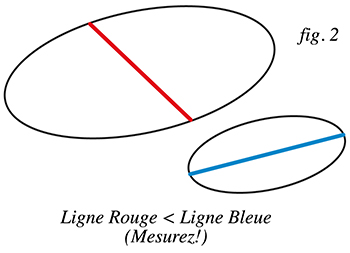
The effect is even more striking when the lines are placed inside ellipses of different sizes. The red line seems subjectively longer, but objectively the blue line is the longer one.