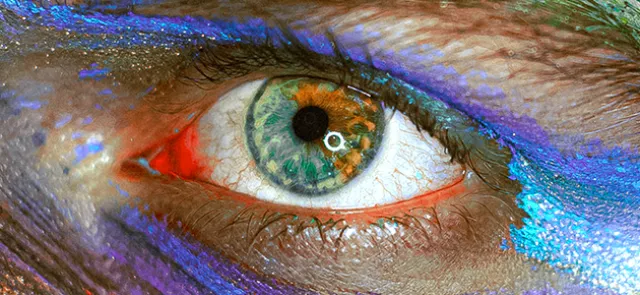
Our world has three spatial dimensions; adding time makes four, providing the framework for theories of relativity. But the images on our screens are flat. They lack depth. To recreate a third dimension artificially, we need to understand how the brain reconstructs it. The visual system is generally considered to consist of the eye, the optic nerve, and the brain. The brain interprets the information collected by the eye in the form of electromagnetic waves (light information). The retina converts these waves into action potentials (brief events during which the electrical potential of neurons—or other cells—rises and then rapidly falls), which travel via the optic nerve to the visual cortex, where images are processed. Curiously, communication between the eye and the visual cortex is relatively limited: most images we identify are the product of the brain's guesses.
One essential fact must be added to this description: we have two eyes, each sending slightly different information to our brain. This can be observed empirically: simply look steadily at an object while closing first one eye and then the other, and subtle differences between the two images become apparent. This is parallax, the effect that a change in position has on everything we perceive. Our brain therefore uses two different images to provide us with a three-dimensional spatial representation. This phenomenon (known as stereoscopy) has been exploited for more than a century and can still be found today in some children's toys, such as the View-Master (Sawyer's, Inc., 1939).
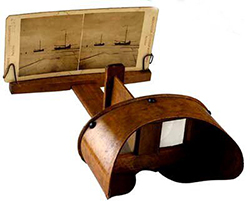
A Holmes stereoscope.
A three-dimensional representation
----------------------------