



Representing volume
Because we live in a three-dimensional universe, representing it has become a technological challenge. All the more so since volume is associated with the representation of motion. On our screens, the development of computer-aided design tools originally met the needs of an industry seeking to move beyond mockup prototyping, which was too costly in terms of time and resources. The volume illusion is achieved by studying the specifics of our visual system, which works from light signals collected by our two separated eyes. Adapted screens or glasses are needed to reproduce it, even if some think that one day this illusion may be obtained from a flat image. But 3D is not limited to the volume illusion. It is physically recreated with the rise of 3D printers, whose process, working layer by layer, or even line by line, is reminiscent of that of scanners.
All articles in this folder
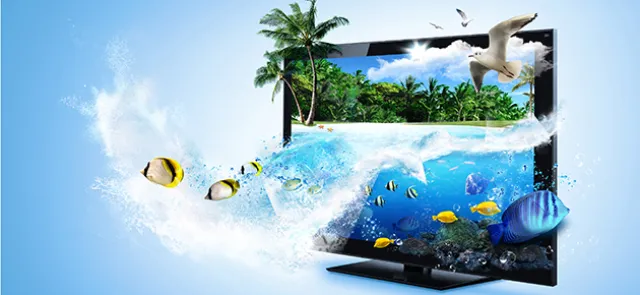
3D television: the TV of tomorrow?
How can the flat screens in our offices and living spaces create the illusion of everyday depth? By showing each eye a slightly different image, they can prompt the brain to create a three-dimensional representation.

Holograms: genuine three-dimensional images?
Envisaged as early as 1892 by Jules Verne in his Gothic novel Château des Carpathes, holograms—three-dimensional images—were not actually theorized until more than half a century later by the Hungarian-British engineer Dennis Gabor (1900–1979), winner of the 1971 Nobel Prize in Physics.
Ray tracing
The ray-tracing technique is used to compose 3D computer-generated scenes.
Could Georges Méliès have discovered 3D cinema?
French illusionist and filmmaker Georges Méliès (1861–1938) is well known for his fantastical, poetic films, which are often seen as dated today.

Three-dimensional printing
3D printing has enjoyed a real surge in popularity in recent years. Do you know how it works?
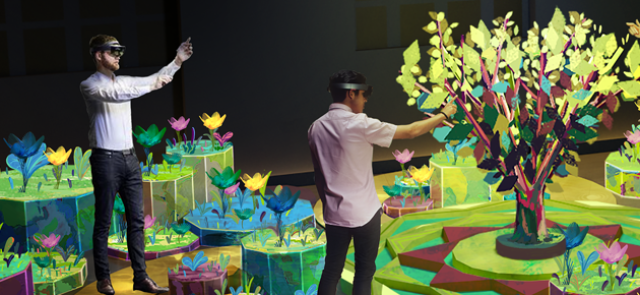
Holo-Math: a new way to visualize mathematics
The Holo-Math project grew out of a desire to offer an innovative form of public engagement, using mixed reality to help people visualize a mathematical concept. It will soon be up and running at the Institut Henri-Poincaré's brand-new Maison Poincaré.
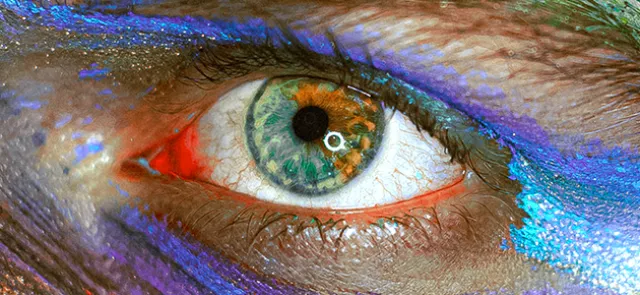
The magic of autostereograms
How can we see a three-dimensional object in a flat image? Glasses and stereoscopes offer technological solutions. Autostereograms, like optical illusions and trompe-l'œil, require no device or apparatus.
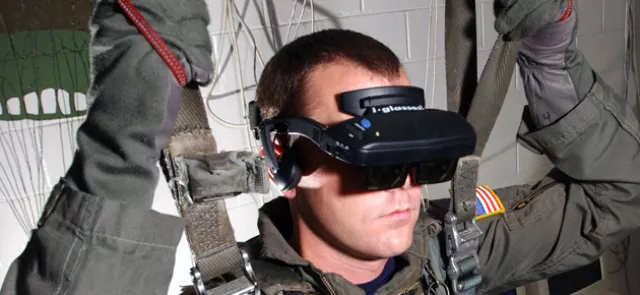
Representing three-dimensional objects
Digital techniques for creating 3D images have been developing since the mid-20th century. Initially driven by the needs of industry and later by those of a wider public, they offer numerous possibilities, including the representation of movement.