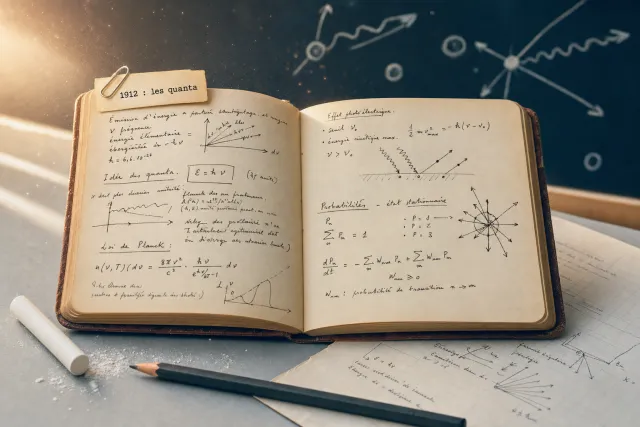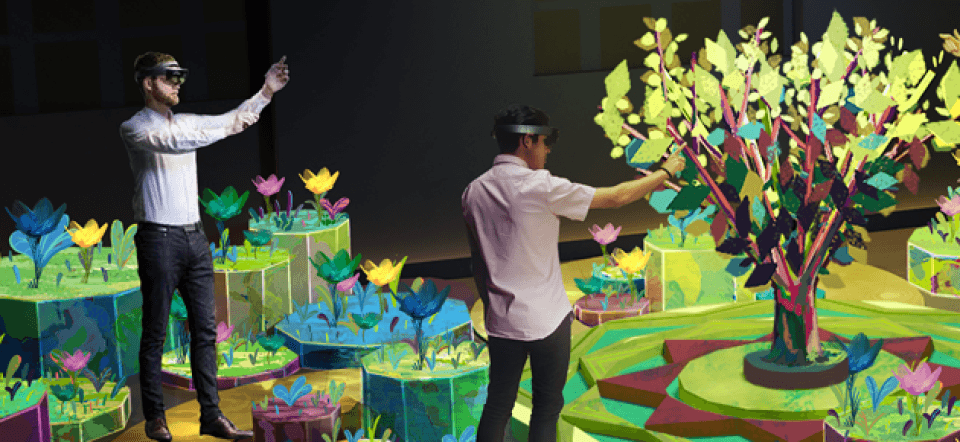
From the outside, there is not much to see: four to six people wearing strange headsets, apparently staring into space; a facilitator explaining a mysterious "Brownian motion" and an invisible "Galton board"; and participants following along, moving around and gesturing in mid-air. All around them is a large hangar or classroom, but nothing that suggests mathematics.
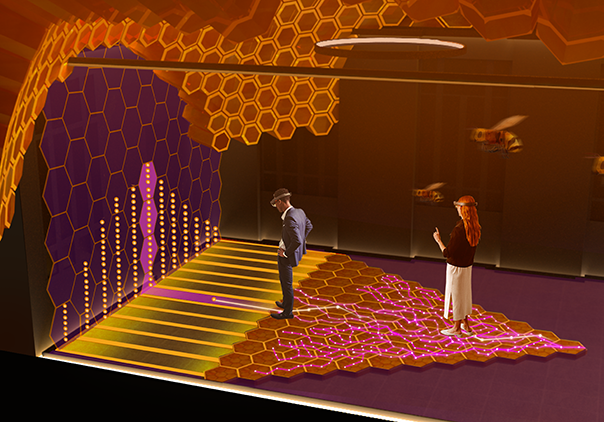
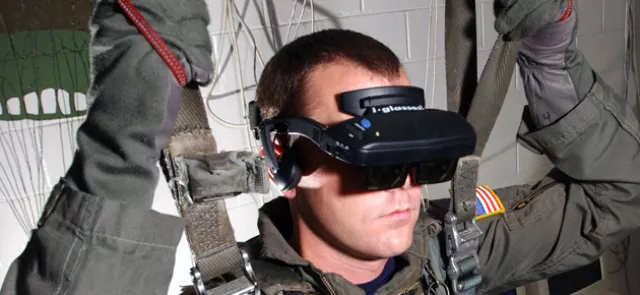
To understand what is happening, you need to put on a HoloLens headset, a sort of oversized pair of glasses with screens that sits over your nose. From within, the experience is very different: the glasses reveal large, three-dimensional virtual objects. Even if the room is dark, everything lights up through the glasses. You can approach these virtual objects, move away from them, walk around them and tap them with your fingers… Most importantly, however, the glasses preserve your view of reality: you can see the other participants and the facilitator guiding the small group through this augmented universe. The subject matter also becomes clearer, as the holograms in the headset illustrate Brownian motion, the Galton board and many other concepts, some mathematical and others physical. This experience is Holo-Math.
Mixed reality
-----------------------
Holo-Math is a science-communication experience using mixed reality—an innovative technology that is still far from widespread. Seen at technology trade shows and in video-game development studios, the HoloLens headsets developed by Microsoft remain largely unknown to the general public. Yet this "general public" is precisely the audience Holo-Math addresses, inviting those who try the experience to put on the glasses and visualize mathematics in a new way. Holo-Math takes us "through the looking-glass" into a universe inspired by Lewis Caroll's Alice's Adventures in Wonderland, where we explore a garden in which everything is mathematical: flowers representing conic sections, others inspired by Penrose tilings (see Tangente 198, 2021), a probability tree… The next stage of the experience zooms in on the microscopic world: step by step, the facilitator takes participants down to the microscopic scale, immersing them in the Brownian motion of a pollen particle. The explanations are supplemented by a few historical images and a second, more playful interaction with a giant Galton board, designed to illustrate the law of large numbers. At the end of the presentation, after an experience lasting around twenty minutes, the return to reality provides an opportunity to consider how these abstract mathematical concepts are applied in our society and everyday lives.