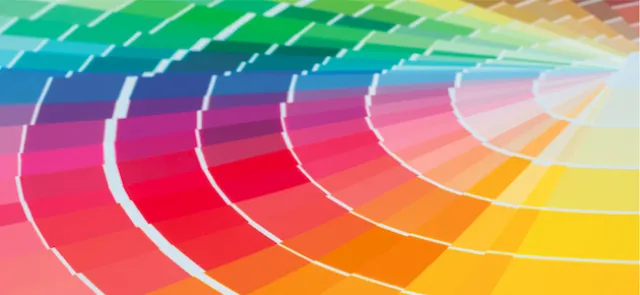
There is nothing natural about the concept of color. The objects around us absorb certain wavelengths of light and reflect others; our eyes detect their frequencies, which are then interpreted by our brains (see "Different color systems"). Colors as we perceive them therefore have no independent physical existence; they depend entirely on our human reality. Nevertheless, color has always been part of our daily lives. In recent decades, it has also taken over our cinema and television screens.

Grassmann's laws and luminance
------------------------------
The world of color is modeled by Grassmann's laws, named after a Prussian mathematician and physicist (see box) who was also one of the unsung pioneers of tensor calculus and vector spaces. These laws confirm that color space is three-dimensional and postulate that colors combine linearly. This assumption of linear color mixing implies that the color perceived by our eyes must be independent of its spectral components.