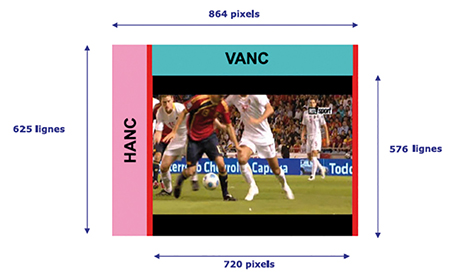

The information received by our television sets is digital. Each image corresponds to a certain number of bits specifying the luminance and chrominance of each pixel (see the article “The components of our images: luminance and chrominance”). But the on-screen image is not the whole story.


Articles recommended for you.

Screens are now part of our daily lives—and taking up more and more space. But how are the images they display constructed? What lies behind the standards (ITU 709, etc.) and formats (4:3, 16:9, etc.) in use?

By breaking each image into blocks and moving into the frequency domain, the JPEG format discards high frequencies, to which our eyes are less sensitive. This is what makes the compression effective. JPEG: vector spaces underpinning image compression!

Medical imaging is an indispensable tool for physicians, whether for diagnosis, prognosis, or surgery. It provides anatomical or functional information about an organ or part of the human body while being either noninvasive or only minimally invasive.

While cryptography seeks to make information unintelligible, steganography aims to conceal the very existence of that information. The idea is to hide it within a drawing, image, text or sound.
Discussion
Sign in to post a comment and talk with other readers.
No comments yet. Be the first to respond.