Raster images, vector images
----------------------------------------
Many image formats rely on concepts from matrix algebra: high-dimensional matrices, algebraic operations on matrices, geometric transformations, and matrix or vector forms of algebraic expressions… Likewise, data representation in computing draws on the language of matrices and vectors: matrices to represent volumes, row or column vectors to represent data sequences, and matrices to encode the pixels on a screen…
The most common raster image formats are JPEG (Joint Photographic Experts Group), the "classic" photo format; GIF (Graphical Interchange); and its successor, PNG (Portable Network Graphic). TIFF (Tagged Image File) and PSD (Photoshop Document), used for image editing, are also common.
The most popular vector image formats are PICT (Apple Picture), which is somewhat dated; PDF (Portable Document Format), designed for efficient document display; PS (Postscript), useful for printing; SWF (Flash), used for Web animations; and SVG (Scalable Vector Graphic), which supports animation and transparency.
Different mathematical approaches
----------------------------------------
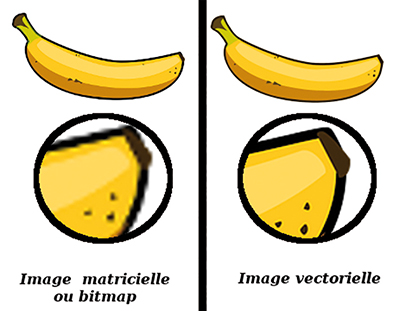
In computing, images come in various formats. Raster images (also called bitmaps) consist of points called pixels (picture elements), each assigned a color. Such an object is therefore nothing more than an ordered, structured array of values. The resolution of a photograph, for example, thus depends on the number of pixels per unit area.
Vector images, by contrast, consist of geometric objects (points, line segments, lines, circles, Bézier curves…) identified by their coordinates. The advantage of vector graphics is that every object in an image can be modified independently. They can also undergo translations, rotations, scaling, and deformations using "handles"…
Image processing
--------------------------
Matrix notation plays a vital role not only in storing digital images but also in modifying them.
In a grayscale image, each pixel is assigned a value from 0 (black) to 255 (white), with the values in between corresponding to 256 shades of gray. In a color image using the RGB (red, green, blue) model, there are 256 levels each of red, green, and blue.
In image processing, one of the most common ways to improve a file's quality is to create image-processing filters. Matrix operations come into play during "convolution." This operation transforms the elements of image matrix A, which is generally very large, using a smaller convolution kernel F. For example, if each pixel in A is to be modified using its eight neighbors, F will be a 3 × 3 matrix. This approach considerably reduces the computational workload involved in image processing.