Antoine Pevsner, born in Belarus in 1884 and died in Paris in 1962, was a Russian artist associated with the Constructivist movement. In 1920, he co-signed the Realistic Manifesto (see box) with his brother Num Gabo, who was also initially associated with Constructivism and later with the Abstraction–Création movement. The two brothers went on to mix with the leading
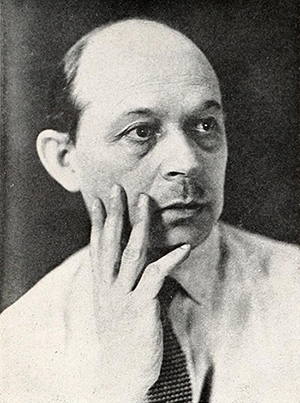
artists associated with geometric abstraction: Theo Van Doesburg, Auguste Herbin and Georges Vantongerloo.
From 1902 to 1916, Pevsner worked primarily as a painter, gradually moving from figurative art towards a more geometric language. In 1923, when he settled in Paris, he began producing his first sculptures. He used a variety of materials, including celluloid and Plexiglas, as well as different metals. His work gradually evolved as geometry assumed an increasingly important role, culminating in the creation of his Developable Surfaces in 1938. He stressed the predominance of the straight line in his works: "You will see that works such as my Developable Surface of 1938 feature curved surfaces \[…] ; but these curved surfaces, often non-developable surfaces, are composed solely of adjacent straight-line segments."
Dynamic Projection at the 30th Degree, created in 1951 from brazed brass painted with bronze powder, is a developable surface combining conical and cylindrical surfaces. The cylindrical surface forms an angle of 30° with the horizontal and appears to rest on the surface of a cone. The work conveys a sense of motion: the cylinder seems to be propelled into space, an effect heightened by the sculpture's upward opening.