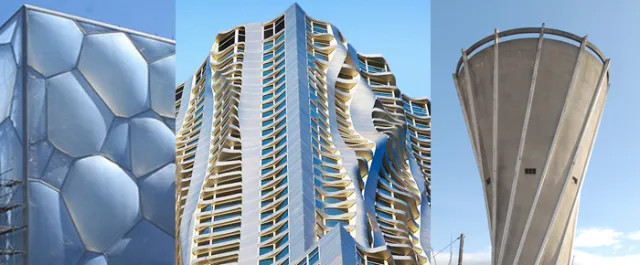
What could be more fascinating than soap bubbles? Soap films, without a doubt. A soap bubble is still just a bubble, and that's a little monotonous. Sure, you can stick two, three, or more together. But a bubble is always perfectly round!
Bubbles and soap films
------------------------
Soap films are considerably more varied. You get them by dipping iron or copper wire frames into a tub of soapy water.
To try this experiment at home, use a mixture of water, dish soap, and glycerin (a very greasy substance available at pharmacies that helps soap films last longer). Otherwise, you can watch the author's video "Bulles de savon (expériences)" (Soap Bubbles [Experiments], 14 min, 2021), which is available online on VideoDiMath, an audiovisual resource website for mathematics.
When you lift the frame back out of the tub, the soap clings to it and forms a surface in space. But not just any surface! If you repeat the experiment with various frames, you observe both great variety and a certain regularity in the shapes the soap takes. What can we say about this? Don't hesitate to try the experiments yourself at home before anything else!
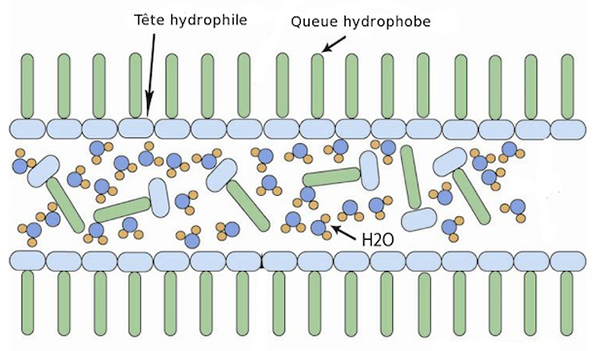
A soap film is made up of a layer of water surrounded by two layers of soap molecules (for a total thickness on the order of a micron). These molecules have a hydrophilic head and a hydrophobic tail, which leads them to arrange themselves as shown in the diagram, with the hydrophilic head pointing inward (toward the water layer) and the hydrophobic tail pointing outward (toward the air). The two outer layers of soap slow down evaporation by keeping the water out of contact with the air. That is why a soap bubble does not burst right away.
The potential energy of a soap film is proportional to its area. At equilibrium (setting aside the effects of gravity or wind), the soap will therefore minimize the area of the film it forms. It will, however, only minimize it locally: this means that if you perturb the surface "a little," its area will increase. On the other hand, it is not certain that the soap will find the smallest possible area; local minima of area are stable. Think of a ball in a hilly landscape. It will be at equilibrium in a hollow, but that is not necessarily the lowest point in the landscape.
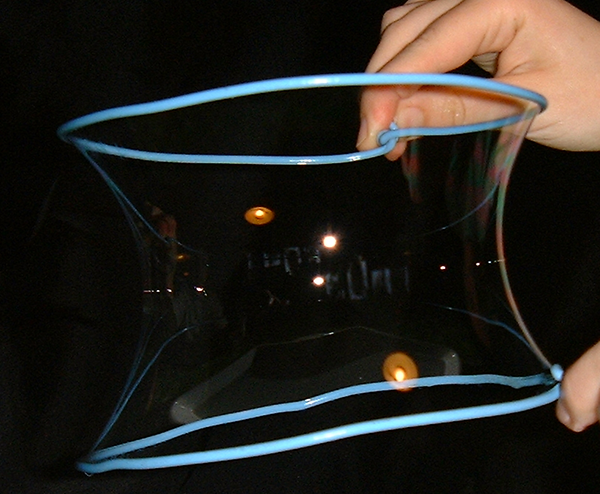
Since the catenoid can be realized as a soap film,
it is a minimal surface.
Minimizing area under constraints
---------------------------------
If the soap takes on these magnificent, regular, yet sometimes surprising shapes, it is simply because it seeks the surface with the smallest possible area under the constraints imposed on it. In soap bubbles, it is constrained to enclose a fixed volume of air: it therefore takes the shape that minimizes area while enclosing a fixed volume.
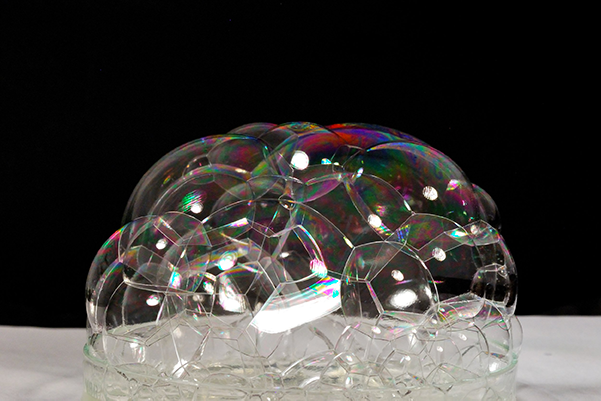
In the case of several bubbles, the soap will find the shape that minimizes the total area while enclosing several distinct, separate volumes (which may be equal or different). For soap films, the constraint is to stay attached to the frame (since the energy needed to detach would be too great). One can also imagine combining these constraints.
And here we are, without even realizing it, in the realm of mathematics. We have reduced the understanding of the shapes of soap films to a well-posed geometric question: what are the properties of minimal-area surfaces under certain constraints?
Before tackling surfaces in space, it is always worthwhile — an essential mathematical move — to simplify the problem. Let's first look at what happens for curves in the plane. Let's try to minimize the total length of a plane curve that must connect a set of points. This is the highway problem. Given a few points in the plane (villages), find a curve (a road network) that connects all these points to one another with minimal total length. You can even do this with soap, by imposing symmetry under vertical translation!
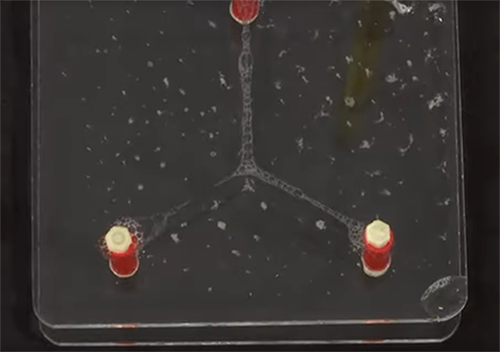
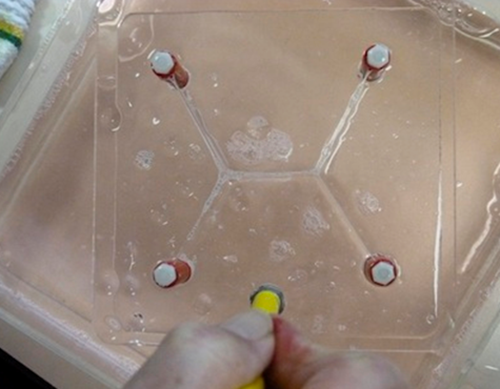
The solution provided by soapy water for three towns and four towns.
To begin with, the roads will be straight, meaning the curve will be made up of straight-line segments (since in Euclidean geometry the straight line is the shortest path joining two points). But these segments can intersect. At each intersection, three roads meet, forming angles of 120 degrees (see for example the author's video "Bulles de savon (explications)" (Soap Bubbles [Explanations], 19 min, 2021), also available on VideoDiMath).
In general, the optimal configuration is not easy to obtain, but algorithms exist to find it. They rely on the proof that only a finite number of possible configurations exist (that is, segments starting from the initial points with three-way intersections at equal angles), so it is enough to test them one by one. But that can take a long time! Another solution is to dip a plate with pegs into the soap; this will give us the solution.
But in space, what replaces straight lines? Surfaces that minimize area are called minimal surfaces. They have zero mean curvature.
Take a surface S and a point on S. The tangent plane is the plane that best "approximates" the surface near that point. In the case of a sphere, for example, it is simply the plane that rests against the sphere at that point. A direction orthogonal to this tangent plane is called the normal to the surface at that point (there are two choices, but one can be fixed).
Now imagine a plane containing this normal direction, that is, a plane orthogonal to the tangent plane. Its intersection with the surface is a plane curve. This curve has a curvature. We give it a sign, calling it positive if the curve bends toward the chosen normal (and negative otherwise). This gives a collection of curvatures corresponding to all the intersections of the surface with planes orthogonal to the tangent plane. A result of Leonhard Euler (1707–1783) states that these curvatures reach a maximum and a minimum in two orthogonal directions. These are the two principal directions, which give the two principal curvatures. The average of these two curvatures is… the mean curvature. To say that this number is zero amounts to saying that, locally, we are always in the saddle-shaped configuration, with the two curvatures equal up to sign.
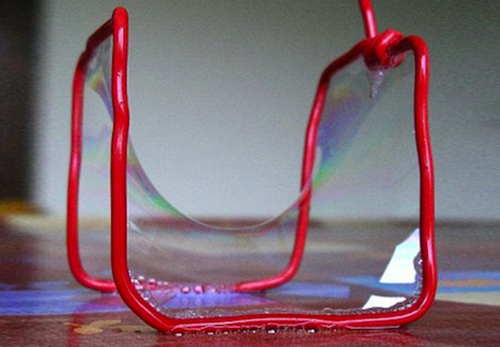
There are thus two main local models of minimal surface: the plane and the saddle with equal curvatures. This world is nonetheless far vaster than that of straight lines in the plane, since these local models can give rise to a great variety of surfaces.
From Joseph Plateau to Jean Taylor
-----------------------------------
In the 19th century, a Belgian physicist and mathematician, Joseph Antoine Ferdinand Plateau (1801–1883), was likewise fascinated by soap films, to the point of writing a voluminous treatise largely devoted to the subject: Statique expérimentale et théorique des liquides soumis aux seules forces moléculaires (1873). By the time Plateau wrote this book, he was blind. But he had made these observations before losing his sight, and he had skilled assistants to redo the experiments. He describes in great detail how to conduct these experiments, how to compensate for the effects of gravity, and how to measure angles with great precision.
From these observations, he arrived at three laws that soap films obey:
• They consist of regular surfaces that are minimal (this is exactly what we have just seen; setting aside the question of regularity, this phenomenon was already known at the time);
• These surfaces intersect three at a time along edges, forming angles of 120 degrees;
• These edges intersect four at a time, forming the angle at the center of the regular tetrahedron (this angle, with an approximate value of 109.47°, is the one whose cosine is and whose sine is ).
These laws, which Plateau did not prove, became a conjecture that stood for a century. In 1976, the American mathematician Jean Taylor (born in 1944) published a proof of these laws in the prestigious journal Annals of Mathematics. And this proves that, against all appearances, this is not a square:
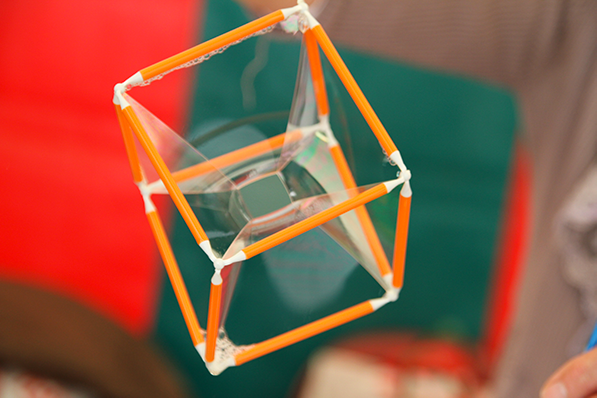
Indeed, if it were one, there would be angles of 90 degrees. But the angles at which the edges intersect must be greater than 109°.
But if the small central figure is not a square, then by symmetry, its sides cannot be straight. This means that the surfaces attached to the boundary, again contrary to appearances, are not planar. They are minimal surfaces, but they are not planes, which would necessarily intersect along straight-line segments.
As it turns out, soap films can be surprising! Moreover, they have not yet given up all their mathematical secrets — far from it…
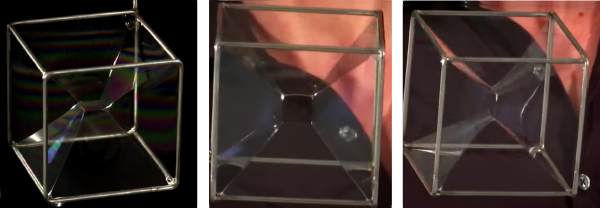
Contrary to what one might think,
dipping a cubic frame into a soapy solution does not produce a "scaled-down model" of the cube. The result has roughly the shape of a square surrounded by non-planar surfaces.
*This text is drawn from the lecture "De Joseph Plateau à Jean Taylor, des bulles de savon bien inspirantes" given by the author on Wednesday, 23 March 2022 as part of the series "Un texte, un mathématicien" at the Bibliothèque nationale de France. Olivier Druet is a CNRS research director at the Institut Camille-Jordan, université Lyon-I. He is also director of the Maison des mathématiques et de l'informatique (MMI) de Lyon.*