



An innovative vision of mathematics
Henri Poincaré revisits each of the mathematical domains he chooses to investigate in his own way. He prefers to think for himself, to rediscover the major results, to emphasize the qualitative study of the solutions of differential equations. In this, he makes an innovative choice that allows him to open vast scientific horizons, or to renew them with creativity, such as non-Euclidean geometries. He thus accumulates original discoveries from which great and rapid notoriety results and which embodies the interaction of the multiple mathematical domains. Bringing topology and geometry into dialogue, he opens paths that, decades after his death, are still fruitful.
All articles in this folder
The calculus of probabilities according to Poincaré | Tangente
Poincaré is rarely associated with the calculus of probabilities. And yet his writings and teaching reveal much about his work and thinking on the subject. Although he did not revolutionize probability theory, he deserves credit for asking the right questions.
The adoption of non-Euclidean geometries
Euclid's fifth postulate differs from the others: it seems provable. Yet its negation leads to other geometries, known as non-Euclidean geometries. They have their place within mathematics and have applications both in arithmetic, as Poincaré showed, and in general relativity.
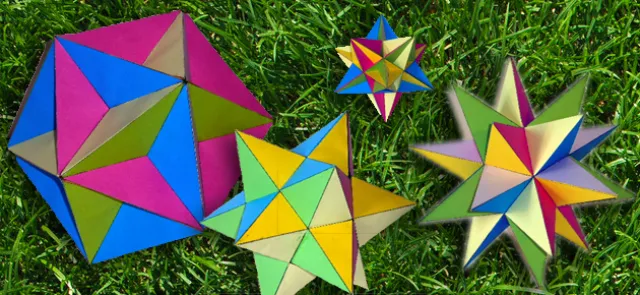
Polyhedra: from Euler's formula to Poincaré's characterization
What is a polyhedron? Throughout history, several characterizations have been proposed, only to be repeatedly undermined by the appearance of "monsters" serving as counterexamples. We look back at this epic story, which reaches its conclusion in Poincaré's work.
Poincaré conjecture in manifold topology | Tangente
By the end of the 19th century, following the work of Poincaré and many other mathematicians, including Bernhard Riemann (1826–1866) and Enrico Betti (1823–1892), the topology of surfaces in our ordinary space was well understood.
Poincaré's qualitative approach to analysis | Tangente
Every high-school student learns how to express the real roots of a quadratic equation explicitly in terms of square roots. This becomes much more difficult for higher-degree equations and impossible from degree five onward.
Poincaré on mathematical induction | Tangente
"This, then, is mathematical reasoning par excellence, and we must examine it more closely" (La Science et l'Hypothèse, "Sur la nature du raisonnement mathématique").
Poincaré's sieve
Poincaré's sieve formula gives the cardinality of a finite union of finite sets in terms of the cardinalities of those sets and their intersections.

Poincaré, an extraordinary student: zero in math | Tangente
The teachers who crossed paths with Henri Poincaré remembered a brilliant, unconventional student.