



Mechanisms and Mathematics
A mechanism is commonly perceived as a device for combining movement. Thus, physics, modeling, mathematics, movement and therefore technologies and mechanisms are intimately linked. They manifest themselves in a thousand clever and elegant ways, through gears, Archimedes' screw, clocks, engines, looms, punched cards and all the machines that human ingenuity has been able to design. Today, electronics has transformed the landscape by integrating other subtle movements: that of electrons and the transmission of information.
All articles in this folder
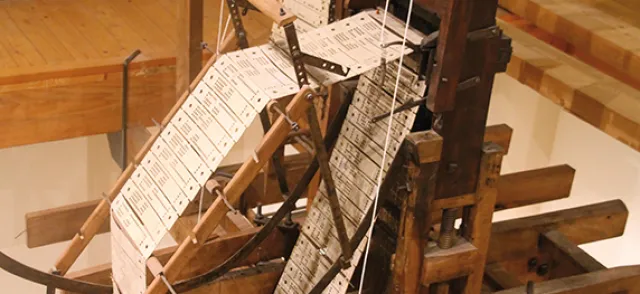
Punch cards: from Jacquard to Hollerith
Interfaces are a defining feature of our culture: the punch-card control system of the Jacquard loom transformed textile manufacturing. But who remembers it today? It was a first step towards the computer, which now governs how we interact with the world.

Jacques Besson and his theatre of mathematical instruments
In the mid-16th century, a French mathematician became fascinated with designing instruments born of his ingenious mind…
A world of oscillations: from Huygens's clock to quantum physics
Huygens's invention of the first pendulum clocks in 1650 helped shape modern differential geometry—with unexpected repercussions for a very recent problem in quantum mathematical physics.
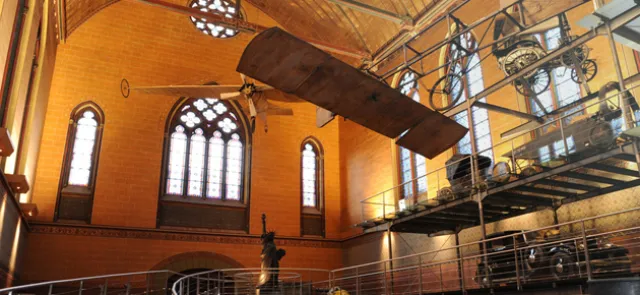
A tour of the Museum of Machines: mathematics and mechanisms at the CNAM
Mathematics isn't visual? You can't really represent it "in the real world," let alone make it tangible? Think again! The Musée des arts et métiers (60 rue Réaumur, 75003 Paris) invites you to revisit its collections… through the surprising lens of mathematics.
The fascination of gears: geometry and mechanics
Gears are both objects of fascination and symbols of mechanics. Determining the shape of their teeth is a sophisticated mathematical problem. Yet this long history, which stretches back to antiquity and is still being written, remains remarkably little known!
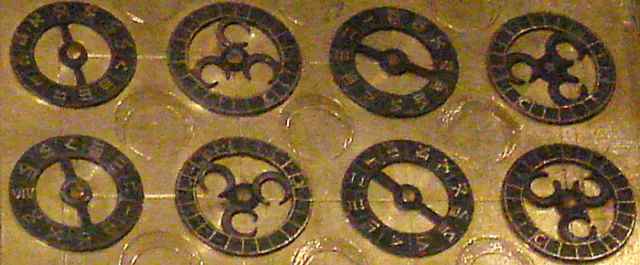
Cryptographic machines: a history of encryption
Since antiquity, people have sought to ensure the secrecy of their correspondence through encryption. Because simple methods were easily decrypted, more sophisticated ones were invented, but they were difficult to use by hand. Machines therefore became essential.