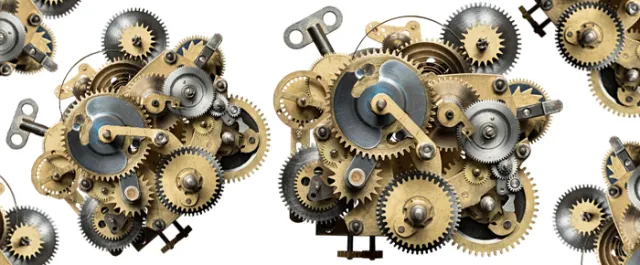
When you bring your hands together and interlace your fingers, you reinvent gears. Turn one hand, and each finger pushes against its counterpart on the other hand, tending to turn it in the opposite direction. Such a simple observation might suggest that gears have existed since the dawn of time. Not so! The earliest explicit evidence of gears appears in the writings of Hero of Alexandria.
Representing fractions
Exactly when Hero lived is a matter of debate. Today, however, the consensus is that he lived in the 1st century AD. The discovery of the Antikythera mechanism (see Tangente 133) pushed the date of the invention of gears back to before 205 BC.
But in 2006, a gear wheel dating from the 3rd century BC was found in Olbia (Sardinia, province of Sassari). It is therefore thought that Ctesibius and Archimedes used gears. In light of these archaeological discoveries, gears have been identified in the Méchanique, attributed to Aristotle (384–322 BC) but more probably written by Strato of Lampsacus; they were formerly taken to be friction wheels.
A gear train is an assembly of at least two gear wheels that mesh together.