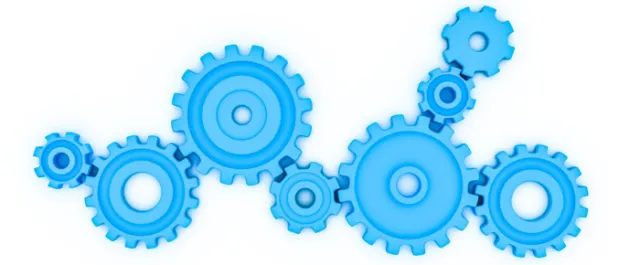
A gear mechanism transmits rotational motion with a constant angular-velocity ratio, as defined by the late expert Georges Henriot. The challenge is to obtain the desired ratio using toothed wheels that mesh with one another.
Each time the driving wheel advances by one tooth, the driven wheel also advances by one tooth. Thus, if the driving wheel has *Z 1 teeth and the driven wheel has *Z 2 (the notation Z is customary in the field), then for every revolution of the driving wheel, the driven wheel makes *Z 1 / *Z 2 revolutions, which does indeed represent a fraction of two integers. A gear mechanism is therefore a mechanical model of a fraction.
From theory to practice
---------------------------
In theory, any fraction of two integers could be represented using gears. In practice, there are limits. First, depending on the type of gears and the technology used, a working mechanism cannot be made if the wheels have fewer than about fifteen teeth. Second, industrial systems can rarely accommodate more than 200 teeth. Third, every tooth on a wheel must be used equally, to distribute wear evenly and prevent premature damage. The *Z 1 and *Z 2 above must therefore have no common factor.
To achieve greater precision using ratios with larger numerators and denominators, we can use a gear train: a succession of wheels that builds up the ratio in stages.