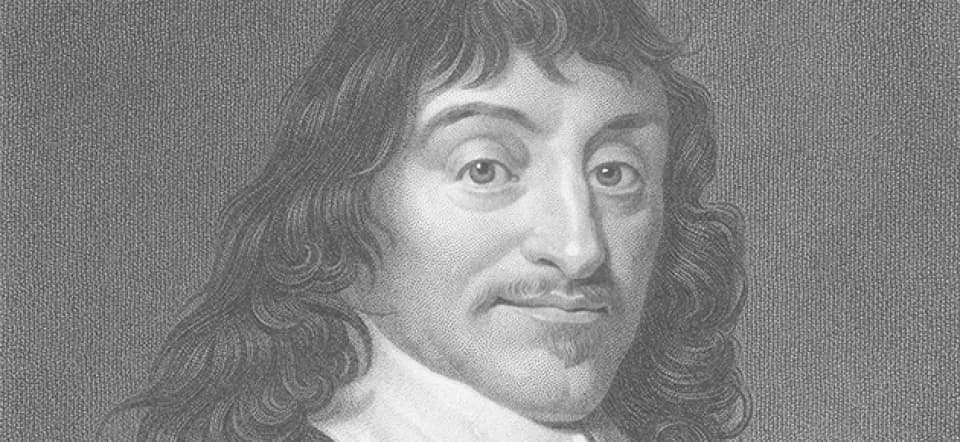
René Descartes's major work is the Discours de la méthode, published in Leiden in 1637, whose aim is to guide reason properly and seek truth in the sciences. Widely regarded as one of the founding works of modern philosophy, the book also introduces three scientific treatises: the Dioptrique, the Météores, and finally the Géométrie. The last of these is Descartes's only mathematical work. There he introduces, among other things, his famous coordinates, now called Cartesian in his honor. They enabled him to establish analytic geometry, bridging the gap between geometry and algebra. The general idea is to solve geometric problems by reducing them to calculations of lengths and expressing them as algebraic equations.
Algebra vs geometry
----------------------
The first book, devoted to "Problems That Can Be Constructed Using Only Circles & Straight Lines," gives a geometric interpretation of algebraic computation and hence of fractions. Descartes makes his intentions clear in the very first sentence: "All problems in geometry can easily be reduced to such terms that, thereafter, one need only know the lengths of certain straight lines in order to construct them."
In other words, Descartes claims that every geometric problem can be solved using algebra. The chapter therefore begins by explaining how to move from one to the other.
He begins with an elementary construction: given two line segments of lengths c and d, it produces a third of length cd. Descartes gives the following procedure: "Let AB, for example, be the unit, and suppose that BD is to be multiplied by BC. I need only join points A and C, then draw DE parallel to CA, and BE is the result of the multiplication."