####
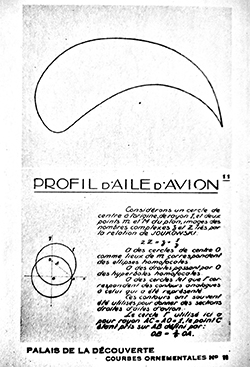
Postcard from 1937.
Every geometry enthusiast eventually wonders: "What is a curve?" As soon as we want to calculate tangents, curvature or singular points, we run up against the need for a practical, convenient definition of a curve.
The most elementary approach is an extensional definition: we draw up an exhaustive list of geometric objects and call them "curves." Lines, circles, ellipses and, more generally, conic sections are examples. This idea soon reaches its limits: any such list is highly subjective. Everyone will want to add their favorite curves, and satisfying every geometer will prove impossible.
So, in 1937, when the Palais de la découverte was founded, André Sainte-Laguë (1882–1950), who headed its mathematics section, had the idea of producing a set of postcards. The front of each featured a notable curve, while the back gave its name, equation, origin and "inventor." Nearly forty years later, at Jean Brette's initiative, the cards were collected in a special issue of the Revue du Palais de la découverte entitled "Courbes mathématiques."
Mechanical properties
-------------------------