The Rubik's Cube group
Who has never tried their luck with this "magic" object, struggling to reconstruct its original configuration? No easy task, given the sheer number of possible positions for those pesky little cubies. Just think! Each of the eight corner cubies has three possible orientations, with the orientation of the last cubie determined by the other seven, giving 37 possibilities. Since these cubies can also be permuted in 8! ways, there are ultimately 37 × 8! possible arrangements of the corners. The twelve edge cubies, which can be permuted in 12! ways and each have two possible orientations, would give 212 × 12! possibilities. However, it is impossible to swap just two corners or just two edges, so the final two corners and the final two edges have only one possible arrangement, which divides the result by 2 × 2. The Rubik's Cube therefore has a total of 37 × 8! × 210 × 12! configurations, or approximately 4.325 × 10¹⁹.
These configurations can be reached using, for example, the six 90° clockwise rotations of the faces (A for the front face, P for the back, B for the bottom, H for the top, D for the right and G for the left). These rotations generate a group. Under the composition convention A \* B = "perform A, then B", the transformations A, B, D, G, H and P generate the Rubik's Cube group.
The records
-----------
With a fairly simple method and enough practice, you can solve a Rubik's Cube in under a minute. Going faster is a little more complicated…
Competitions are held regularly. The best competitors can solve a cube in under ten seconds. The official record, set on November 24, 2018, stands at 3.47 seconds and is held by a young Chinese competitor, Yusheng Du. He shattered the previous record of 4.59 seconds, held by Australian Feliks Zemdegs, himself no stranger to setting records.
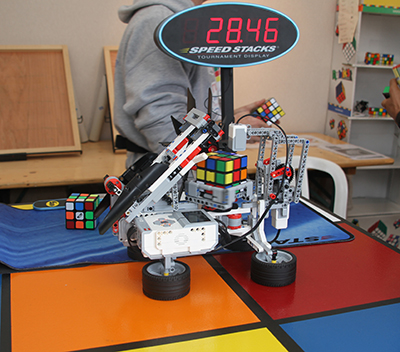
In fact, that record is slower than the one held by a robot since March 7, 2018: it took just 0.38 seconds! The robot and its interface were designed by two students at the Massachusetts Institute of Technology (MIT) in the United States. The software was developed by a German teacher, Herbert Kociemba.
God's number
-----------------
Cubers call a quarter-turn of one face (in either direction), or a half-turn, an elementary move. There are therefore eighteen possible elementary moves. The question is: what is the maximum number of elementary moves needed to solve the cube from any given position? This integer NRC is known as God's number for the Rubik's Cube.
In July 2010, using an exhaustive computation, American computer scientist Tomas Rokicki, working with other scientists including Herbert Kociemba, showed that NRC = 20. This result required several weeks of distributed computing on Google LLC computers. He also showed that the mean number of moves needed to solve the cube is 17.7.
Purists who might argue that a half-turn is not an "elementary move", since it can be obtained by performing two successive quarter-turns, can rest easy: if only quarter-turns are allowed, God's number is 26. To distinguish it from the previous number, it is called God's number in the quarter-turn metric. It was determined in 2014.