



Norbert Verdier
21 articles published in Tangente
 History and CultureN°96Dec 01, 2025
Karine Chemla, mathematician and sinologist
Karine Chemla is a central figure in the history of mathematics in China, which she has helped make accessible to a wide audience. A mathematician, historian and translator all at once, she looks back on her rich career and her work.
Read → Math for everyoneN°95Aug 20, 2025
Divisibility in nineteenth-century textbooks
Divisibility rules are numerous and are used by everyone who practises mental arithmetic. Blending arithmetic with common sense, they are a source of countless mathematical recreations, and have long been used in teaching.
Read → History and CultureN°93Feb 11, 2025
Ahmed Djebbar, in the service of history
If the history of Arab science attracts interest today, it is largely thanks to Ahmed Djebbar, who not only made it his field of study but also did much to bring the subject to a wider audience.
Read → History and CultureN°222Feb 07, 2025
In Clairaut’s footsteps
Alexis Clairaut is probably little known today. Yet his writings inspired many scientists. A compilation of 19th-century publications reveals a fame that has since faded.
Read → History and CultureN°91Aug 25, 2024
A man of conviction
Cauchy's century was a veritable political laboratory: France passed through a succession of radically different regimes. Amid this constant change, Cauchy, a Legitimist, showed no lack of courage in defending his beliefs. Yet he remained steadfastly devoted to science, even when it meant helping regimes for which he had little sympathy.
Read →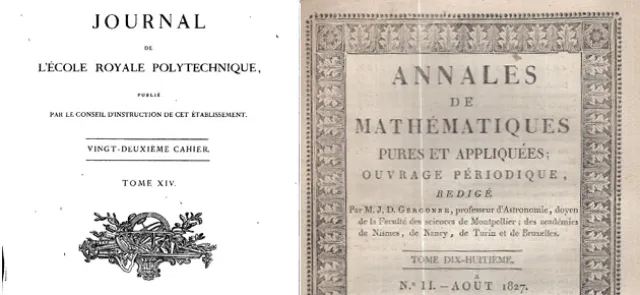 History and CultureN°91Aug 24, 2024
The rise of specialist journals
As the press expanded dramatically in the 19th century, advances in science prompted the creation of new publications devoted to scientific research.
Read →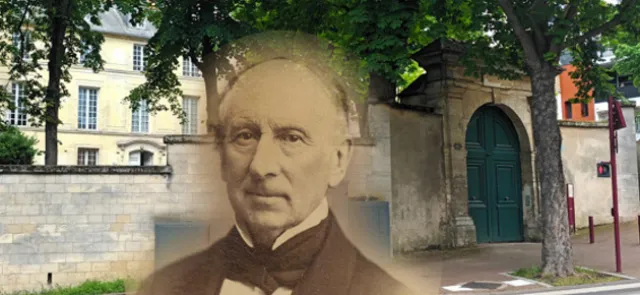 History and CultureN°91Aug 24, 2024
From Arcueil to Sceaux, in Cauchy's footsteps
Cauchy had close ties to the southern suburbs of Paris. After growing up in Arcueil, he spent his holidays in Sceaux, where he produced some of his mathematical work. He also died and was buried there.
Read → History and CultureN°89Feb 19, 2024
Denominators without end
Continued fractions—stacks of fractions that never end—have been studied by some of the greatest mathematicians, including Euler and Lagrange, as well as Galois. Let's take a closer look at these fractions and their strange denominators.
Read →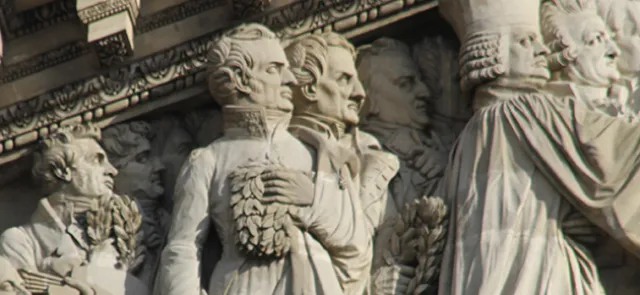 History and CultureN°88Nov 21, 2023
A giant for the ages
Laplace's scientific output is colossal. A tireless researcher, the "French Newton" also devoted himself to making the latest discoveries widely known and to providing scientific training for new generations.
Read → Math for everyoneN°88Nov 16, 2023
A fresh perspective on differential equations
The method developed by Laplace and his successors replaces differentiation with multiplication, turning a given differential equation into a "simple" algebraic equation. Today, no one working with differential equations can do without this technique.
Read → History and CultureN°82May 19, 2022
A standard reference for historians
The Revue d’histoire des mathématiques—a leading journal for historians, published by the Société mathématique de France—devoted a special issue to Évariste Galois in 2011 (volume 17, no. 2).
Read → History and CultureN°82May 18, 2022
Papers, papers, and still more papers…
Although Galois's "complete" works were published in 1962, they can be "completed"—a kind of paradox of completeness—with his papers from the 1829 entrance examination for the École préparatoire. They are held in the Archives nationales. Let us open them! Some of them have never been published.
Read →