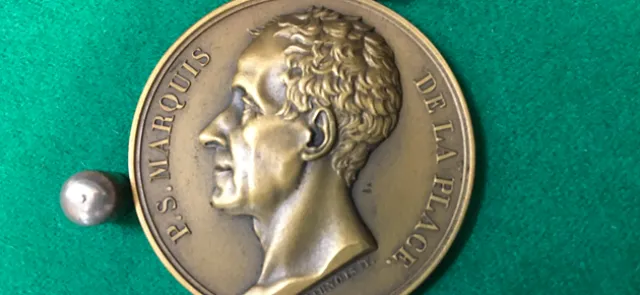
The so-called Laplace transform appears incidentally in the mathematician's statistical research from 1782 onward, merely as an intermediate computational device generalizing a family of solutions to differential equations introduced by Euler in 1744. The scholar from Normandy also drew considerable inspiration from Lagrange's research on planetary oscillations.
His name remains associated with this transform, although dozens of others helped develop and apply it. His role was acknowledged in 1880, when Henri Poincaré (1854–1912), following George Boole (1815–1864), adopted the term "Laplace transform". The expression has since gained universal acceptance.
The Laplace transform
----------------------------
Modern courses generally introduce it as follows. It is an integral transform: it takes a function f to another function F. Here, F is defined, whenever possible, by: