Yet many results had already been proved without any formal framework by the end of the previous century. One example is the spectral theorem, which states that every symmetric matrix is diagonalizable in an orthonormal basis.
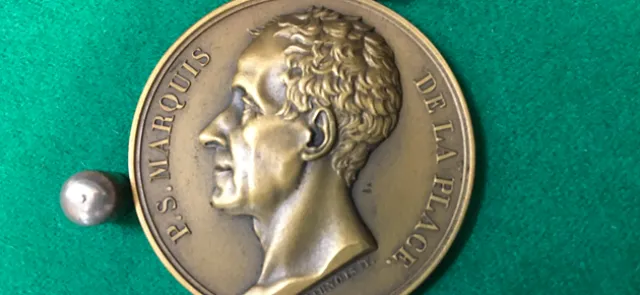
In the mid-18th century, d’Alembert, followed by Euler, investigated the motion of a rigid body. The search for axes of rotation led to the search for eigenvalues and eigenvectors. Euler and then Lagrange subsequently studied similar problems to prove the stability of the Solar System. Laplace took up this work and improved Lagrange’s method by exploiting the symmetry of the coefficients.
In 1826, Cauchy approached the problem in purely mathematical terms and settled the case in which all the eigenvalues are distinct; Weierstrass would obtain the general result in 1858.
Laplace and determinants
---------------------------
The Scottish mathematician Colin MacLaurin (1698–1746) introduced determinants while seeking to solve systems of linear equations, around 1729, although his work was not published until 1748, posthumously, in his Treatise of Algebra. In 1750, the Swiss mathematician Gabriel Cramer (1704–1752) sought to determine the coefficients of a conic passing through five points. In his book Introduction à l’analyse des lignes courbes algébriques, published in 1750, he gave the modern definition of the determinant.