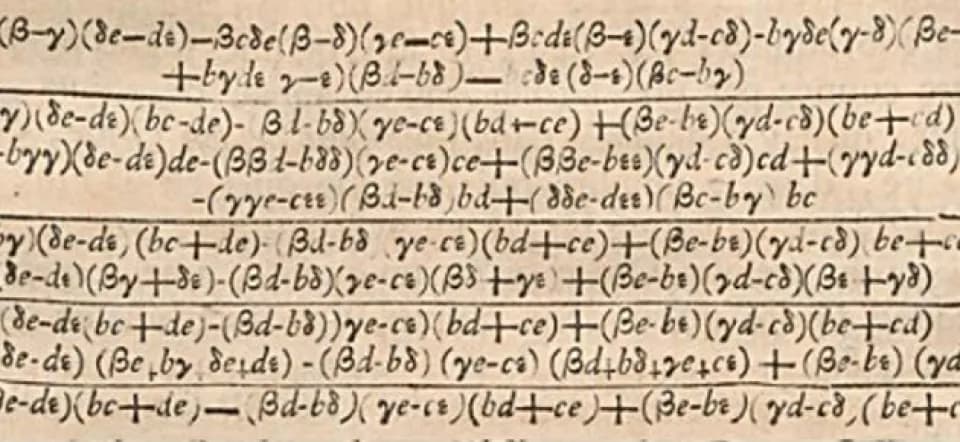
Throughout his Introduction à l’analyse des lignes courbes algébriques, Gabriel Cramer announces two important results in footnotes, referring readers to two appendices published at the end of the book. Beyond their intrinsic mathematical importance and historical value, these two texts also reveal just how difficult it was to manipulate complex algebraic expressions using the notation available in the mid-18th century.
Calculating a determinant of arbitrary order
The first note appears in the third chapter, which deals with the different orders of algebraic curves. Here, the order is the highest degree. For example, the equation A + By + Cx + Dy 2 + Exy + x2 = 0 is of order 2: it is a conic. Using his analytical triangle (see the article "Drawing an algebraic curve in the 18th century"), Cramer establishes that the number of points needed to define a curve of order n is .
This result can be understood intuitively from the analytical triangle (see the article "Drawing an algebraic curve in the 18th century"): the first row, corresponding to order 0, contains one cell; the second, corresponding to order 1, contains two cells; and so on.
Thus, for a curve of order n, there are 1 + 2 + … + (n + 1) cells (even if some coefficients are zero), making (n + 1)(n + 2)/2 cells. But an equation can always be divided by one of its nonzero coefficients, thereby making that coefficient equal to 1. Consequently, the number of coefficients sufficient to define an equation of order n is the number of cells minus 1: [(n + 1)(n + 2)/2] – 1, which is n(n + 3)/2.