



Gabriel Cramer, a 'friendly scholar'
While Gabriel Cramer's name is today inseparable from the famous rule learned in high school for solving linear systems, his work goes well beyond that. Mathematician, professor, publisher, he is also, and this is not a weak word, a 'friendly scholar', to use Daniel Bernoulli's fond memory of him. His masterpiece remains his Introduction to the Analysis of Algebraic Curves, published in 1750 and celebrated by d'Alembert in about ten articles in the Encyclopédie. Let us discover his contributions to algebra, including the proof of what will be called Bézout's theorem, and even the surprising 'paradox' of Euler-Cramer.
All articles in this folder
 Podcast
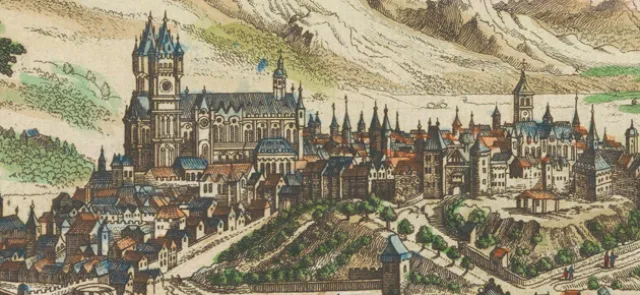
Gabriel Cramer: the journey of an 18th-century Genevan mathematician
Explore Gabriel Cramer's journey, from his education in Geneva to his European Grand Tour among the leading mathematicians of his day.
 Podcast
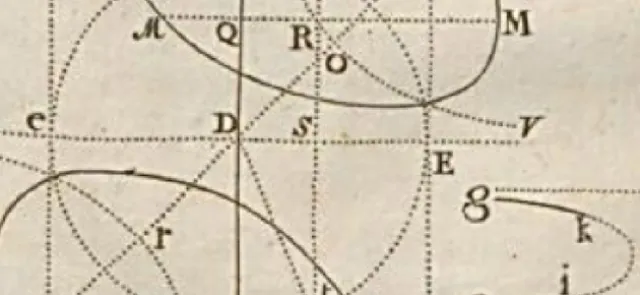
Plotting algebraic curves in the 18th century: Newton’s and Cramer’s analytic methods
How did Gabriel Cramer plot algebraic curves in 1750? Discover Newton's analytical parallelogram and Cramer's analytical triangle.
 Podcast
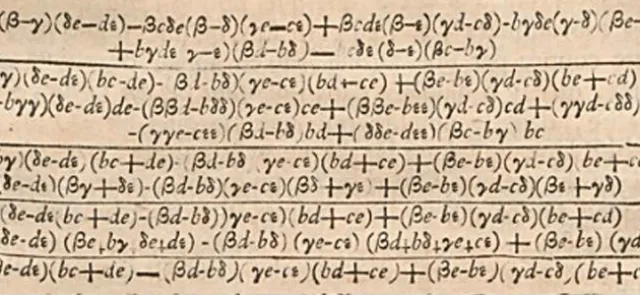
Gabriel Cramer and Cramer's rule in the 18th century
The appendix to Gabriel Cramer's Introduction à l’analyse des lignes courbes algébriques contains the famous rule for solving systems of linear equations and Bézout's theorem.
 Podcast
Euler–Cramer paradox: Are 9 points enough to define a cubic?
The Euler–Cramer paradox: If nine points seem sufficient to determine a cubic curve, how can two distinct cubics also pass through those same nine points?