Gabriel Cramer's name is still associated with a paradox concerning the number of points needed to define a curve of a given degree* unambiguously: Do nine randomly chosen points define a unique cubic curve, several such curves, or even infinitely many?
(The degree of a plane curve defined by a Cartesian equation in two variables is the maximum value attained by n + m in expressions of the form x ny m *.)
A surprise
The year was 1744. Having devoted all his time to teaching mathematics at the Académie de Genève and editing the Œuvres complètes of the brothers Jean and Jacques Bernoulli (see the article "Itineraries of a Genevan mathematician"), Gabriel Cramer resumed work on his Introduction à l’analyse des lignes courbes algébriques, which he had begun in 1740 (the book would not ultimately be published until 1750). In doing so, he stated two results that seemed obvious to him: (1) a curve of degree n is defined by n × (n + 3) / 2 points, and (2) two curves of degrees m and n intersect at mn points (see the article "A decisive contribution to algebra"). Thus, a line is defined by 1 × (1 + 3) ⁄ 2 = 2 points, and two lines generally intersect at 1 × 1 = 1 point. A conic (an algebraic curve of degree 2) is determined by 2 × (2 + 3) ⁄ 2 = 5 points, and two conics—for example, a parabola and an ellipse—generally intersect at 2 × 2 = 4 points.
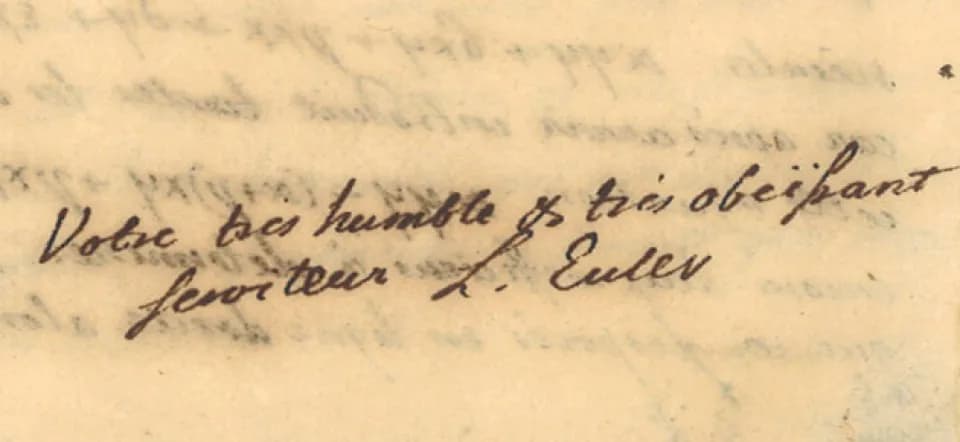
But he realized that these two results seemed wholly contradictory when, for example, m = n = 3 (or greater). He expressed his surprise to Leonhard Euler (1707–1783) in a letter dated September 30, 1744. Having read in an English journal, in an article by a certain Mr Braikenridge, that a curve of degree n could be defined by n2 + 1 points (which is plainly false), he wrote (with spelling modernized):