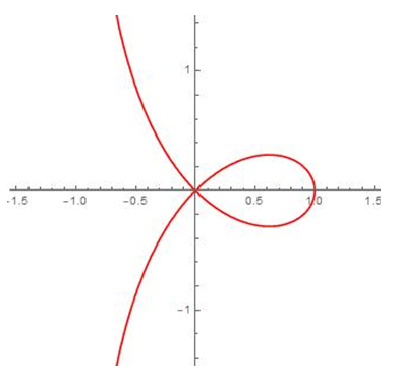
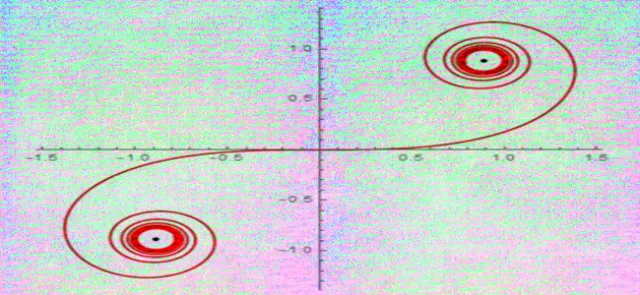
Following the "invention" of analytic geometry—with the introduction of coordinates—by René Descartes in his seminal work Géométrie (1637), and the work of Pierre de Fermat at the same time, mathematicians began systematically studying curves defined by an equation of the form P(x, y) = 0, where P is a polynomial in two variables. Descartes called them geometric curves; today they are known as algebraic curves. For example, the algebraic curve given by the equation x 2 + 2 y 2 − 2 x − 2 = 0 is an ellipse. The curve defined by y 2 (1 + x) = x 2 (1 − x) is a special cubic: a strophoid. It has a double point. The curve with equation (x 2 + y 2 − 1)3 − x 2 y 3 = 0 is a sextic: it is Beutel's heart. Two cusps can just be made out.
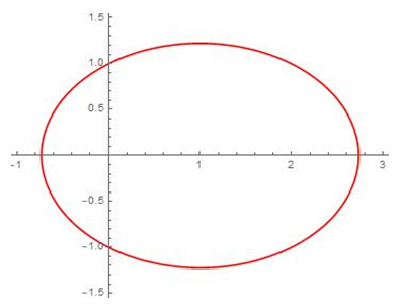
An ellipse.