Smooth cubics
-------------------
The genus of an algebraic curve of degree n is a topological invariant: it is equal to if the curve has no singular points (in which case it is said to be smooth). Each double point reduces the genus by one. A cubic—an algebraic curve of degree 3—is therefore elliptic if it is smooth.
Conics have genus zero and are called rational because they can be parametrized by rational functions, as can the unit circle:
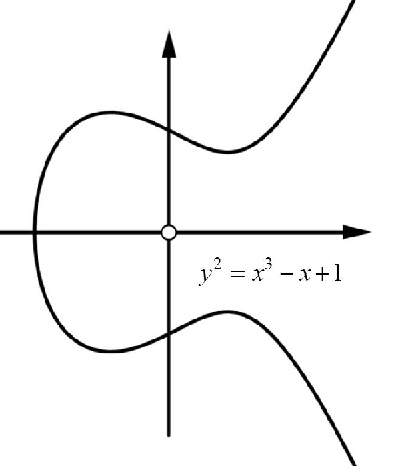
Every rational curve has a single component (one continuous trace when points at infinity are included), but the converse is not true. The genus-1 elliptic curve with equation
y 2 = x 3 − x + 1 (shown below) has a single component but is not rational. It can, however, be parametrized by elliptic functions (which historically arose from the rectification of the ellipse).